
In the global food industry, certifications such as FSSC 22000, ISO, and BRCGS are widely recognized as proof of compliance with established food safety and quality standards.
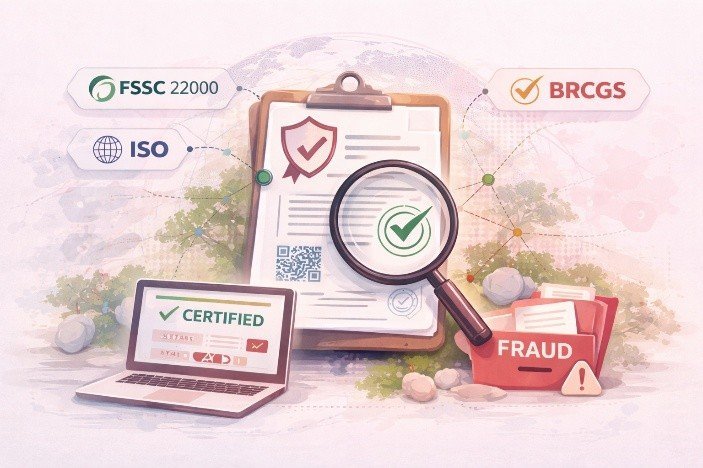
These certifications are often required for supplier approval, regulatory acceptance, export eligibility, and participation in international supply chains. However, as certification becomes increasingly important, instances of misinterpretation and fraudulent documents have also emerged. Relying solely on a copy of a certificate without proper verification can expose organisations to compliance risks and reputational damage.
For procurement teams, auditors, and quality professionals, verifying the authenticity of food safety certifications is essential due diligence. Confirming that a certificate is valid, current, and issued by a recognized body helps protect consumer safety, maintain regulatory compliance, and strengthen trust within the supply chain.
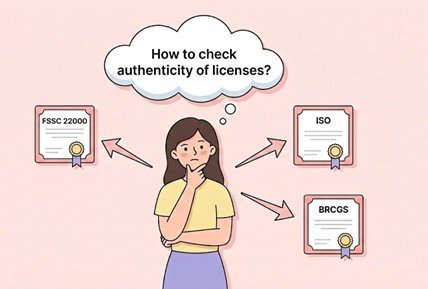
In the following sections, we will understand how to verify the authenticity of these certifications and ensure they are issued through legitimate and recognised systems.
| Check Points | ISO | FSSC 22000 | BRCGS |
| Logo |  |  |  |
| Check Certification Body | Certificate shall be issued by an approved certification body. You can verify the accredited CB. The link helps you to filter out CBs based on the country. | Certificate shall be issued by an approved certification body. You can verify the accredited CB. The link helps you to filter out CBs based on the country. | Certificate shall be issued by an approved certification body. You can verify the accredited CB. The link helps you to filter out CBs based on the country. |
| Verify Accreditation | The certification body should be accredited by an accreditation body recognized by the International Accreditation Forum (IAF). Note: Check if it is accredited. Accreditation provides independent confirmation of competence. However, accreditation is not compulsory, and non-accreditation does not necessarily mean the certification body is not reputable if it follows ISO/IEC 17021-1. | Certification body should be accredited by an accreditation body recognised by the International Accreditation Forum (IAF). | Certification body should be accredited by an accreditation body recognised by the International Accreditation Forum (IAF). |
| Verify through official directory/register | Verify through the certification body database or contact directly. Verify using the link. | Verify via company name, COID (Certificate Organisation Identification Code) or QR code; contact FSSC if not listed. Verify using the link. | Certificate status can be independently verified site-by-site through the BRCGS directory. Verify using the link. |
| Validate Certificate Details | Request a copy and then check the 1) certification number 2) Issue/expiry dates 3) Scope 4) ISO standard. | Verify referenced standards such as ISO 22000, applicable PRPs and the current FSSC scheme version. | Routine track live certification status to ensure continued validity. |
| Review Certificate Format/Logo | The certificate should include: 1) Organisation name 2) Address 3) Certification body 4) ISO standard 5) Version 6) Scope 7) Certificate number 8) Accreditation logo ISO does not permit the use of the logo on certificates. | Logo: 1) Check design 2) Proportion 3) Format Note: Distorted logos may indicate a fake. Certificate Format: 1) Proper alignment 2) Uniform fonts 3) Professional typography 4) No spelling errors 5) Scope 6) Food Chain Category 7) Validity 8) Name of the Company and its address 9) Logo of the certifying body 10) FSSC Logo 11) IAF Logo 12) COID Cod 13) Certificate Number | Authentic certificate PDFs downloaded directly from the BRCGS directory can be used to compare format, logo usage, and document layout to confirm genuineness. The certificate should have, 1) BRCGS Logo 2) Organisation name 3) Scope 4) Product Categories 5) Certificate Number 6) Issue date 7) Expiry date 8) Certifying body logo |
Conclusion:
Certifications such as FSSC 22000, ISO, and BRCGS are valuable only when they are authentic and properly accredited. Verifying food safety certifications through registers, accreditation bodies, and issuing certification bodies helps prevent fraud, reduce compliance risks, and protect organizational credibility.