
Background
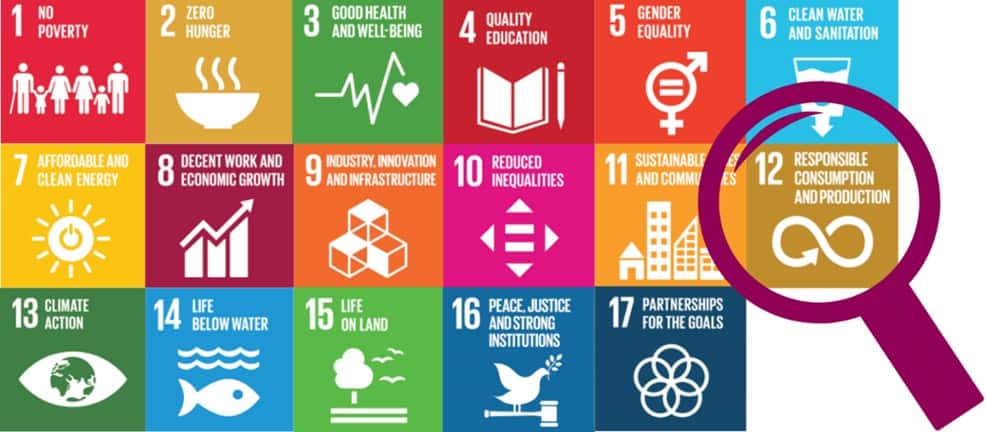
FSSC 22000 food loss and waste management has become a vital part of building a sustainable food system. Sustainability has moved from being a niche concern to a central pillar of global policy-making. Over the past two decades, governments, international organisations, and industry leaders have acknowledged that the way we produce, consume, and dispose of food is placing unsustainable pressure on our planet’s resources. In 2015, the United Nations formalised this recognition by adopting the 2030 Agenda for Sustainable Development, which set out 17 Sustainable Development Goals (SDGs) as a blueprint for a better future.
Among these goals, SDG 12, Responsible Consumption and Production, addresses the urgent need to manage natural resources efficiently, minimise waste, and ensure sustainable supply chains. Within SDG 12, Target 12.3 specifically calls for halving per capita global food waste at the retail and consumer levels and reducing food losses along production and supply chains, including post-harvest losses, by 2030.
Staggering statistics drive this target: farmers lose roughly 8% of food at the farm level, supply chains lose 14% between farm and retail, and consumers, retailers, and food service waste 17% at later stages. These losses translate to more than US$1 trillion annually and account for 8–10% of global greenhouse gas emissions, making food loss and waste one of the largest contributors to climate change. Meanwhile, nearly one in ten people worldwide remains undernourished, underscoring the moral and economic urgency of the problem.
In this article, we will focus on SDG Target 12.3, its integration into the Food Safety System Certification (FSSC) 22000 scheme, and how businesses can take a structured approach to food loss and waste reduction as part of their sustainability strategy.
Introduction to FSSC 22000 Food Loss and Waste Management
The FSSC 22000 food safety certification scheme has evolved to reflect not only food safety requirements but also broader sustainability concerns. By integrating FSSC 22000 food loss and waste management into its framework, the scheme directly supports SDG 12.3 and encourages organisations to embed waste reduction practices into their daily operations.
This is not merely about compliance; it is about building a food system that is more efficient, resilient, and environmentally responsible. Businesses adopting these practices stand to gain multiple benefits: reduced operational costs, improved resource efficiency, stronger brand reputation, and a tangible contribution to combating climate change and global hunger.
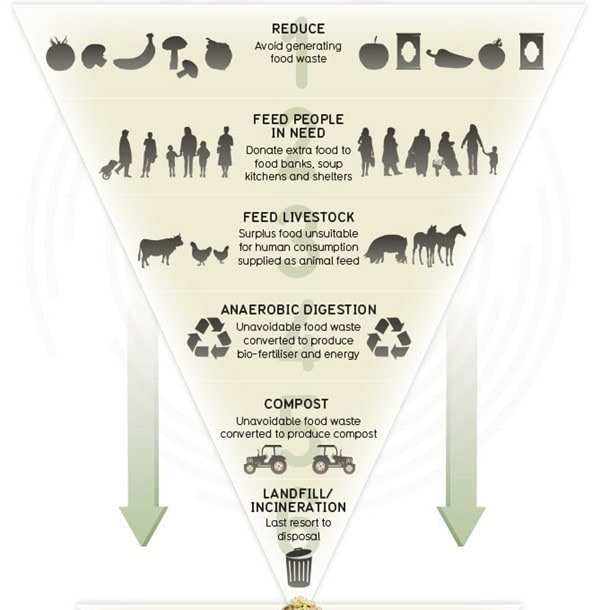
Effective food loss and waste management follows a hierarchy of actions, with prevention and reduction at the top, followed by repurposing, recycling, and recovery. The less sustainable options, such as disposal, should be a last resort. Understanding this hierarchy is key to implementing meaningful waste reduction strategies.
The Food Waste Pyramid
The Food Waste Pyramid, also known as the Food and Drink Material Hierarchy, illustrates the preferred order of actions for managing food loss and waste. It guides organisations to use resources efficiently while minimising environmental impact. The pyramid includes the following levels:
- Prevention – Avoid generating waste by improving planning, storage, and processing to minimise losses in raw materials, ingredients, and finished products.
- Optimisation – Redirect surplus food to people in need or convert it into animal feed.
- Recycling – Process inedible food waste into compost or renewable energy through anaerobic digestion.
- Recovery – Incinerate with energy recovery to reduce landfill use.
- Disposal – The least preferred option: landfill, incineration without energy recovery, or discarding into sewers.
The aim is to keep operations as high up the pyramid as possible, with prevention and reuse as the primary focus.
Definitions in the FSSC Context
FSSC 22000 Version 6 guidance clearly defines the scope of food loss and waste (FLW) to ensure consistency in measurement and reporting:
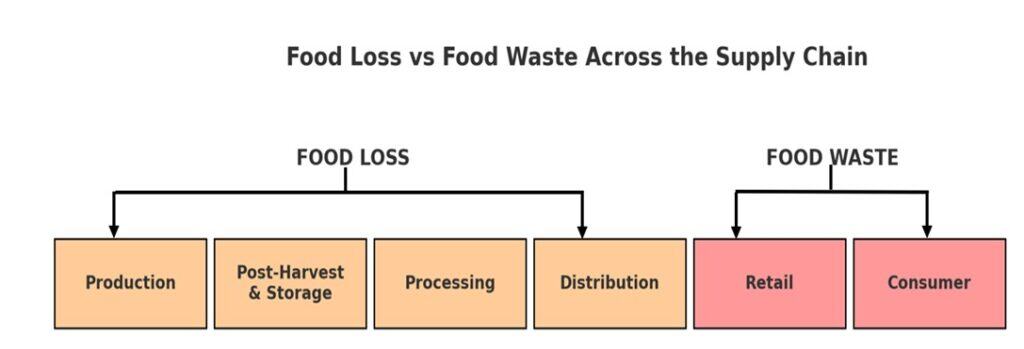
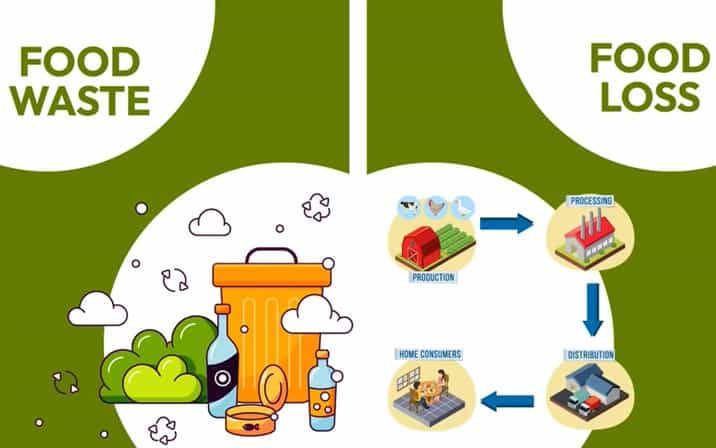
- Food loss refers to food that does not reach the consumer due to inefficiencies in the production, processing, storage, or distribution stages of the supply chain
- Food waste refers to food that is fit for human consumption but is consciously discarded at the retail or consumer level.
Scope under FSSC:
- The requirement applies to food products including ingredients, additives, beverages, and pet food intended for human or animal consumption. The scope excludes packaging materials, but it considers edible packaging (such as rice paper wraps or edible films) as food.
- The scope of FSSC 22000 excludes pre-harvest losses because farming activities fall outside its coverage. These losses typically refer to reductions in crop yield before harvesting, caused by pests, diseases, weather conditions, or poor agricultural practices.
- The scope includes both edible and associated inedible parts removed from the food supply chain once they are no longer intended for consumption.
- Examples of edible parts: rejected batches of bread due to labelling errors, surplus dairy past its commercial date, or beverages discarded because of packaging defects.
- Examples of inedible parts: fruit peels, bones, shells, husks, or coffee grounds separated during processing.
- The requirement also extends to rescued or donated food supplied to secondary markets or charitable organisations, provided such redistribution is safe, traceable, and compliant with applicable legislation.
Implementation Guidance under FSSC 22000 for Food Loss and Waste Management
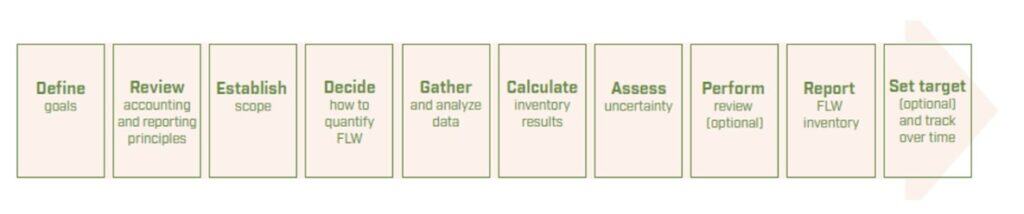
Clause 2.5.16 – Food Loss and Waste in the FSSC 22000 scheme goes beyond a generic sustainability gesture; it provides a structured, measurable, and audit-ready approach to food loss and waste management. The Target–Measure–Act cycle forms the operational backbone of this requirement, ensuring that waste reduction moves from good intention to verifiable performance.
1. Target – Establishing the Baseline and Objectives
The process begins with quantifying current food loss and waste to establish a baseline. This involves mapping every point in the production and supply chain where losses occur — from raw material intake to storage, processing, packaging, distribution, and any downstream partners under the organisation’s control.
- Root cause analysis is critical — whether losses are due to poor demand forecasting, equipment inefficiency, storage conditions, product specifications, or process design.
- Objectives must be specific, measurable, and time-bound, covering both short-term (quarterly/annual) and long-term (5–10 years) targets.
- Prioritization is key: focus first on high-volume, high-value, or high-environmental-impact waste streams.
2. Measure – Tracking Progress and Waste Destinations
Regular monitoring ensures that objectives remain on track and helps identify trends.
- Measurement should be consistent in method, scope, and frequency to ensure comparability over time.
- FSSC guides organisations to track not only the quantity of waste but also its destination—whether they repurpose, recycle, recover, or dispose of it.
- The aim is to move waste “up the pyramid” — for example, shifting material from disposal to animal feed or redistribution.
3. Act – Continuous Improvement and Corrective Actions
Organisations must implement corrective actions when they fail to meet targets. This could mean redesigning processes, upgrading storage facilities, revising shelf-life parameters, or improving supplier specifications.
- Even if targets are met, organisations are encouraged to seek further reduction opportunities — ensuring a culture of continuous improvement rather than compliance minimums.
- Actions should be evaluated for their impact not only on waste reduction, but also on food safety, cost efficiency, and environmental benefit.
Strengthening Compliance and Efficiency under Clause 2.5.16
FSSC 22000 further requires that food loss and waste strategies comply with legislation, remain current, and never compromise food safety. Documented evidence of objectives, measurements, and results must be maintained and reviewed during management reviews. The guidance calls for efficiency improvements to reduce downgraded or discarded products, with clear targets to minimise such losses. Where safe, non-compliant products may be redirected to alternative markets instead of disposal, thereby reducing food waste while recovering economic value.
Shelf-life validation is also encouraged, as extending shelf life within safety limits can reduce premature disposal. Effective stock rotation practices such as FIFO (First In, First Out) and FEFO (First Expired, First Out) are essential to ensuring products are utilized before expiry, minimizing avoidable losses.
Sector-Specific Application
The FSSC guidance tailors the requirement to different food chain categories:
- Food Chain Category E Organizations- Catering and Food Service: Focus on recipe management, multi-use ingredient planning, portion control, and customer education.
- Food Chain Category F Organizations- Retail, Trading, Wholesale and E-Commerce – Engage consumers through awareness campaigns, improve stock rotation, and collaborate with suppliers to reduce upstream losses.
- Food Chain Category G Organizations- Transport & Storage: Maintain temperature control, minimize handling damage, and use FEFO/FIFO principles rigorously.
- Food Chain Category K Organizations- Production of Bio/Chemicals: Explore alternative uses for downgraded material, avoiding disposal wherever possible.
Strategic Benefits for Certified Organisations
Effective food loss and waste reduction delivers value far beyond compliance:
- Audit readiness with documented evidence and verifiable results.
- Cost savings through improved efficiency and reduced disposal expenses.
- Environmental benefits including reduced greenhouse gas emissions and conservation of land, water, and energy.
- Enhanced reputation by aligning with global sustainability goals and consumer expectations.
Conclusion
The integration of SDG 12.3 into FSSC 22000 through Clause 2.5.16 reflects the recognition that food safety and sustainability are inseparable. By adopting structured policies, measurable targets, and sector-specific controls, organizations can significantly reduce waste, strengthen their food safety management systems, and contribute to a more sustainable global food chain.
How Food Safety Works can help you?
At Food Safety Works, our regulatory and technical team can assist in developing and reviewing your food loss and waste policies, ensuring compliance with FSSC 22000 Version 6 while delivering measurable sustainability outcomes.