

Why can a pinch of salt make coffee taste less bitter? Why does lemon make an overly sweet drink seem more balanced? And why is milk more effective than water against a red chilli burn?
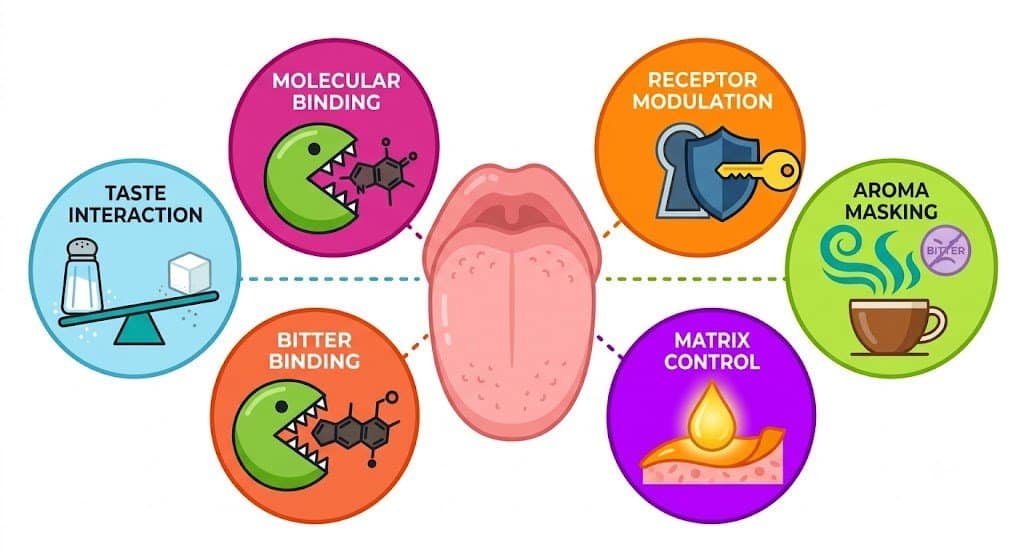
These effects are examples of taste interaction, molecular binding, receptor modulation, aroma and mouthfeel working together.
Taste masking does not necessarily remove the offending compound. Instead, it changes how strongly that compound is perceived by altering its availability, receptor interaction, competing tastes, aroma or release in the mouth.
Regulatory Compliance Note: For commercial product formulation, all taste-masking ingredients, modulators, and novel additives must comply with applicable local food safety authorities, such as the Food Safety and Standards Authority of India (FSSAI) under its Food Products Standards and Food Additives Regulations, adhering strictly to permitted use levels and category-specific approvals.

The Five Main Tools of Taste Masking
Effective taste masking generally relies on one or more of these mechanisms:
1. Taste-taste interaction
One taste can suppress or modify another. For example, sweetness and sodium can suppress perceived bitterness, while sweetness can also suppress saltiness. The effect depends strongly on concentration and food matrix. (PubMed Central (PMC))
2. Molecular binding
Proteins, lipids, polymers and cyclodextrins can bind or associate with certain undesirable compounds, potentially reducing their availability to taste receptors.
3. Receptor modulation
Specialised compounds can interact directly with taste receptors and reduce their response. Lactisole, for example, inhibits the human sweet receptor by interacting with the T1R3 component.
4. Aroma masking
Because flavour perception involves both taste and smell, a suitable aroma can reduce the sensory dominance of an undesirable taste.
5. Matrix and release control
Fat, protein, viscosity, emulsification, encapsulation and other structural factors can change how rapidly a compound is released in the mouth.
The strongest systems often combine several of these mechanisms rather than relying on one ingredient.
2. Masking Excessive Bitterness
Bitterness is primarily detected through the TAS2R family of bitter receptors. It is particularly challenging in protein hydrolysates, botanicals, pharmaceuticals, nutraceuticals and certain functional ingredients.
- First line: sweetness + salt
Small amounts of sodium can suppress bitterness, while sweetness can provide additional sensory masking. This is a well-established taste interaction, although the optimum level is highly formulation-dependent.
Practical approach:
Bitterness → controlled sweetness + very low salt + compatible flavour
This is generally more effective than simply increasing sweetness until the bitterness becomes less noticeable.
- Second line: molecular sequestration
For particularly difficult bitter compounds, physical approaches can prevent or reduce their interaction with taste receptors.
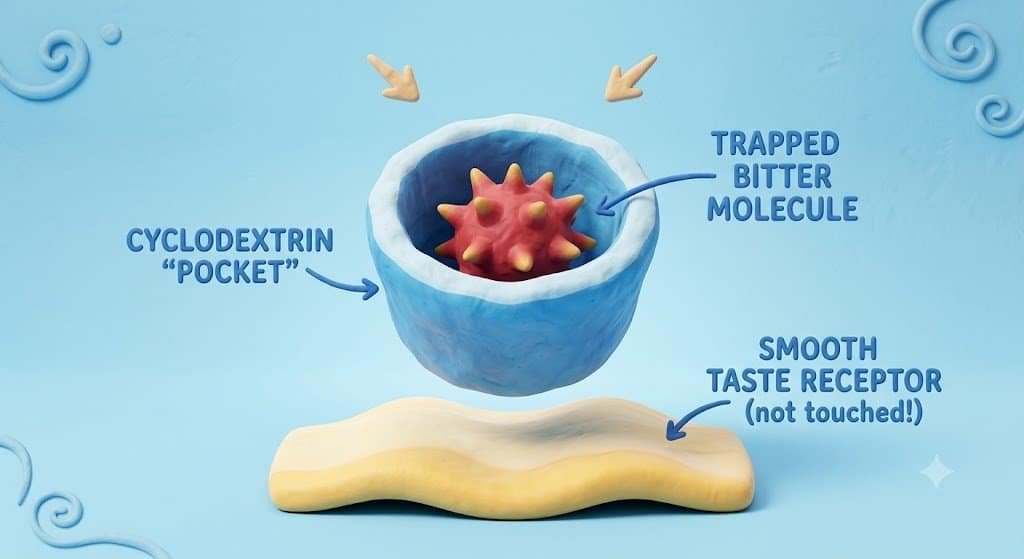
Cyclodextrins are especially interesting. Their molecular structure can form inclusion complexes with suitable hydrophobic compounds, reducing the concentration of free bitter molecules available in the mouth.
Research has demonstrated bitterness reduction with cyclodextrins for compounds including naringin, limonin, ginseng components and protein hydrolysates, although effectiveness varies considerably according to the bitter compound, cyclodextrin type and ratio.
Important: Cyclodextrin is not a universal bitterness blocker. The host-guest chemistry must be suitable for the specific bitter molecule.
- Third line: specialised bitterness modulators
Certain flavour-modifying and bitter-blocking compounds act at the receptor level. Before industrial use, one must ensure that these special modulators are explicitly permitted under their market’s food additive framework (such as FSSAI’s approved additive list for nutraceuticals or health supplements).
3. When a Product Is Too Sweet
Sweetness is primarily mediated through the T1R2/T1R3 receptor complex.
The simplest way to reduce the perception of excessive sweetness is to introduce sensory contrast.
Acidity
Citric, malic and lactic acids can provide sourness that balances sweetness.
- Citric acid → bright, immediate acidity
- Malic acid → longer, smoother tartness
- Lactic acid → softer, rounded acidity
The acid does not remove sugar or sweetener. It changes the overall sensory balance.
Aroma and flavour contrast
Citrus, tart fruit, ginger, mint and mild herbal profiles can make a highly sweet formulation feel less cloying.
Advanced approach
Lactisole is a well-characterised inhibitor of the human sweet receptor, acting through T1R3. It demonstrates that sweetness can be reduced by modifying receptor response rather than simply removing sugar.
Its use in commercial foods requires appropriate regulatory evaluation.
4. Correcting Excessive Saltiness
When a product is genuinely too salty, masking should not replace concentration correction.
Most effective approach:
Dilution → increase unsalted matrix → reformulate salt level
A common kitchen belief is that potato selectively “absorbs” excess salt. In reality, potato does not selectively remove sodium from a dish.
Once the salt concentration has been corrected, sensory balance can be improved through:
- Acidity
- Controlled sweetness
- Umami
- Aroma
- Fat or viscosity
Taste interactions are complex, but sweetness and other taste qualities can alter perceived saltiness.
For reduced-sodium products, umami and kokumi can be especially valuable for maintaining flavour impact and mouthfulness without simply adding more sodium
5. Controlling Excessive Sourness
Excessive sourness can arise from either:
Too much acid chemically
or
an acid system that is perceived as excessively sharp.
If the acid concentration is too high:
- Dilution
- Acid reduction
- Appropriate buffering
- Reformulation of the acid system
may be required.
If the acidity is acceptable but too sharp:
Sweetness + flavour + mouthfeel + acid blending
can create a smoother profile.
For example, a combination of citric and malic acids can produce a different temporal acidity profile from either acid used alone.
6. Controlling Extreme Spiciness
Chilli heat is different from basic taste.
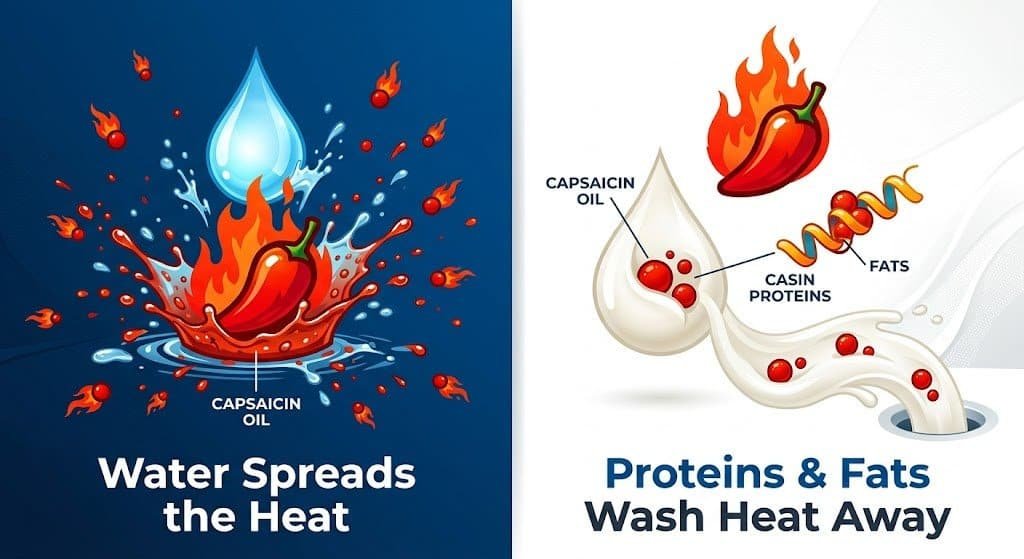
Capsaicin activates TRPV1, a heat/pain-sensing receptor, producing the characteristic burning sensation.
Because capsaicin is highly lipophilic, water is relatively ineffective at removing it from the oral environment.
Milk and dairy proteins can be considerably more effective. A human study found that increasing milk-protein concentration reduced free capsaicin and reduced perceived oral burn, with micellar casein showing a stronger effect than whey protein under the conditions studied.
Practical principle:
Extreme chilli → manage capsaicin partitioning/release + protein/fat system + flavour balance
This is why a suitable protein/fat-containing matrix can be much more effective than simply adding water.
7. Masking Astringency
Astringency should not be confused with bitterness.
Bitterness = taste
Astringency = predominantly a drying, rough or puckering oral sensation
Tannins and other polyphenols can interact with salivary proteins, disrupting oral lubrication and increasing friction.
Possible strategies:
- Reduce excessive tannin extraction during processing
- Introduce suitable proteins
- Modify fat/mouthfeel
- Use appropriate hydrocolloids
- Investigate polyphenol-binding systems
Protein-polyphenol interactions can sometimes reduce the amount of free polyphenol available to interact with saliva, but the effect depends strongly on the specific compounds and matrix.
Therefore, process control is often preferable to trying to mask extremely high astringency after processing.
8. Managing Metallic Taste
Metallic taste is particularly formulation-specific.
Potential causes include:
- Iron and other mineral salts
- Vitamin/mineral premixes
- Oxidation
- Mineral-ingredient interactions
- Packaging-related effects
- Off-flavour formation
Therefore, metallic taste should first be diagnosed rather than simply covered with flavour.
A practical sequence is:
Identify source → evaluate mineral form → check pH and oxidation → optimise flavour → evaluate binding/encapsulation → review packaging
For mineral-fortified beverages, this can prevent the common outcome of simply creating a product that tastes like “fruit + metal.”
9. Building Depth with Umami & Kokumi
Sometimes the problem is not one specific unpleasant taste. The product may simply feel thin, weak or incomplete.
Kokumi is associated with sensations such as:
- Mouthfulness
- Continuity
- Richness
- Thickness
- Flavour depth
Certain γ-glutamyl peptides interact with the calcium-sensing receptor (CaSR) and can enhance the perception of existing tastes rather than producing a strong basic taste themselves. (PubMed)
Recent structural research has further demonstrated the interaction of γ-glutamyl-valyl-glycine with CaSR, providing molecular evidence for this mechanism. (PubMed)
This makes kokumi particularly interesting for:
- Reduced-salt foods
- Low-fat products
- Plant proteins
- Functional beverages
- Products requiring greater mouthfulness
10. Quick Taste-Masking Selection Guide
| Serial No. | Sensory problem | Primary approach | Useful tools |
| 1 | Too bitter | Suppress + sequester + flavour | Salt, sweetness, flavour, cyclodextrins, specialised blockers |
| 2 | Too sweet | Create contrast | Citric/malic/lactic acid, flavour, bitterness/contrast |
| 3 | Too salty | Correct concentration first | Dilution, unsalted matrix, acidity, umami |
| 4 | Too sour | Reduce sharpness | Dilution, sweetness, acid blending, buffering |
| 5 | Too spicy | Control capsaicin interaction | Protein, dairy/fat systems, emulsification |
| 6 | Too astringent | Manage polyphenol-saliva interaction | Protein, mouthfeel modification, process optimisation |
| 7 | Too metallic | Identify source | Mineral-form optimisation, pH, flavour, encapsulation |
| 8 | Too flat | Increase depth | Umami, kokumi, aroma, mouthfeel |
| 9 | Strong aftertaste | Control release | Encapsulation, matrix modification, flavour optimisation |
11. A Practical Development Strategy
For product development, taste masking works best as a controlled sensory optimisation process.
Step 1: Identify the problem
Is it:
Bitter? Sweet? Sour? Salty? Spicy? Astringent? Metallic? Aftertaste?
Step 2: Identify the cause
Determine whether the problem comes from:
The active ingredient → pH → mineral → oxidation → flavour → processing → matrix → release rate
Step 3: Select the appropriate mechanism
Taste interaction
→ salt, sweetness, acidity, umami
Molecular binding
→ protein, cyclodextrin, encapsulation
Receptor modulation
→ specialised taste modulators
Matrix modification
→ fat, protein, hydrocolloid, emulsion
Aroma masking
→ compatible flavour system
Step 4: Optimise systematically
Only one or two variables should be changed per trial wherever possible.
Evaluate:
Initial taste → intensity → onset → duration → aftertaste → mouthfeel → overall acceptability
A formulation with low initial bitterness but a long, unpleasant aftertaste should not be considered successfully masked.

The Golden Rule of Taste Masking
The question should not simply be:
“What ingredient can remove this taste?”
Instead:
“Which part of the sensory pathway can be changed?”
An unpleasant compound can potentially be:
bound → encapsulated → slowed in release → suppressed by another taste → modified at the receptor → masked by aroma → balanced through mouthfeel.
The most successful formulations therefore rarely depend on a single “magic” ingredient.
Taste masking is ultimately sensory engineering.
The objective is not necessarily to eliminate the offending molecule – it is to ensure that the overall sensory experience is balanced, acceptable and stable throughout consumption
Conclusion:
Taste masking relies on scientific principles like taste interactions, molecular binding, and receptor modulation to transform unpalatable products. FSSAI regulations ensure masking agents and additives used in India are safe and category-compliant. Mastering these pathways enables developers to systematically engineer balanced, enjoyable food and nutraceutical products.
Ensuring FSSAI Compliance:
Ensuring regulatory compliance is just as critical as perfecting flavour formulation. Approved additive limits, compliant labelling, and validated claims are essential to meeting FSSAI requirements. Food Safety Works helps businesses navigate these obligations through ingredient reviews, label compliance support, licensing, and end-to-end support, bringing your products to market with confidence.