Frozen treats are often grouped together under the umbrella term “ice cream,” yet they differ significantly in their ingredients, manufacturing process, nutritional composition and regulatory definitions.
While consumers commonly choose products based on flavour or texture, understanding what legally defines each product helps make more informed purchasing decisions.
Ice Cream
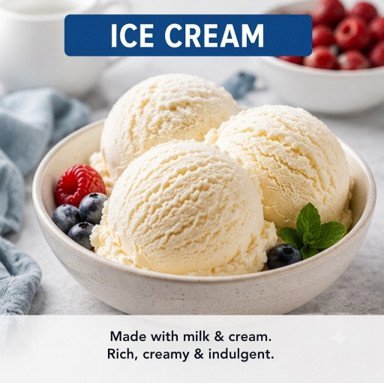
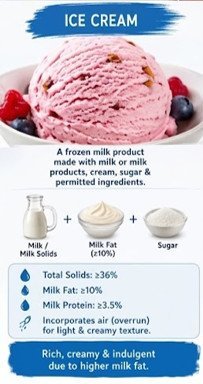
According to the Food Safety and Standards Authority of India (FSSAI) under Regulation 2.1.14 – Standards for Ice Cream, Kulfi, Chocolate Ice Cream, Softy Ice-Cream, Milk Ice, Milk Lolly and Dried Ice Cream Mix, Ice Cream, Kulfi, Chocolate Ice Cream and Softy Ice Cream are frozen milk products prepared by freezing a pasteurised mix made from milk or milk products, with or without nutritive sweeteners and other permitted ingredients. The product may contain incorporated air during freezing and is generally hardened after freezing, except softy ice cream which is served in a semi-frozen state.
FSSAI compositional requirements
Ice cream must contain at least:
Table 1. Comparative compositional and sensory characteristics of ice cream, vegetable fat-based frozen desserts, gelato, and sorbet.
| Sl. No. | Parameter | Minimum Requirement |
| 1. | Total solids | 36% |
| 2. | Milk fat | 10% |
| 3. | Milk protein | 3.5% |
The use of milk fat is mandatory for products marketed as ice cream in India. Similar standards exist internationally, with the USDA also requiring a minimum of 10% milk fat for standard ice cream.
The manufacturing process typically involves blending ingredients, pasteurisation, homogenisation, ageing, freezing with controlled air incorporation (overrun) and hardening. Air incorporation improves body, texture and scoopability while reducing the formation of large ice crystals.
Ice cream is characterised by its rich, creamy mouthfeel due to its relatively high fat content and balanced incorporation of air.
Frozen Dessert
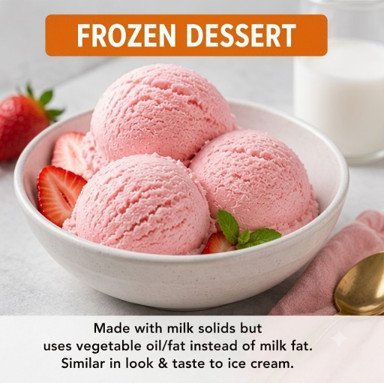
One of the most common misconceptions is that frozen dessert is simply another name for ice cream. In reality, FSSAI clearly distinguishes the two products.
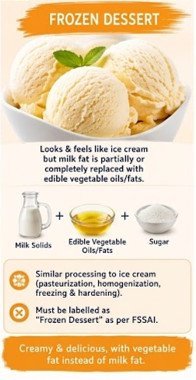
Frozen desserts resemble ice cream in appearance, texture and manufacturing process but differ primarily in the source of fat. Instead of milk fat, frozen desserts contain edible vegetable oils or vegetable fats, either partially or completely replacing dairy fat.
Although both products undergo similar processing – including pasteurisation, homogenisation and freezing; the replacement of milk fat influences flavour release, melting behaviour and mouthfeel.
Frozen desserts are often produced using vegetable fats such as refined palm oil or coconut oil, making them generally more economical to manufacture. However, the use of vegetable fat does not imply that the product is inferior or unsafe. FSSAI requires frozen desserts to comply with strict food safety, labelling and quality standards, and manufacturers are legally required to declare the product as “Frozen Dessert” on the label rather than “Ice Cream.”
Thus, the primary distinction lies in fat source rather than food safety or quality.
Gelato
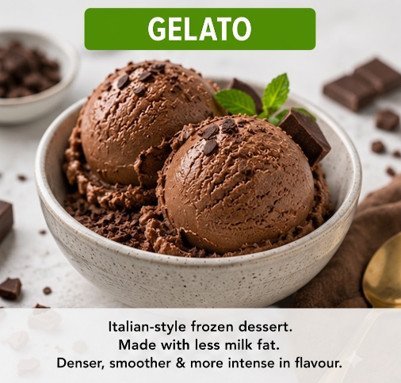
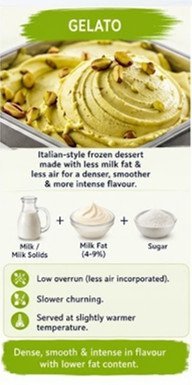
Gelato is the traditional Italian style of ice cream and differs from conventional ice cream mainly in fat content, air incorporation and serving temperature.
Unlike standard ice cream, gelato generally contains 4-9% milk fat, making it lower in fat than conventional ice cream. More importantly, gelato is churned at a slower speed, incorporating significantly less air (low overrun). The lower amount of incorporated air gives gelato a noticeably denser and smoother texture.
Gelato is also served at a slightly warmer temperature than conventional ice cream, making it softer and allowing flavour compounds to be perceived more readily by the palate.
Because fat can coat taste receptors, the lower fat content further enhances flavour intensity, particularly in fruit and nut varieties.
Although gelato is often perceived as healthier, its calorie content varies depending on ingredients, sugar level and flavour formulation.
Sorbet
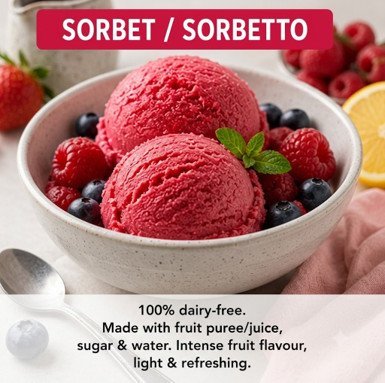
Sorbet is fundamentally different from both ice cream and gelato because it contains no dairy ingredients.
Traditionally, sorbet is prepared from fruit purée or fruit juice, sugar and water, producing a frozen dessert with intense fruit flavour and refreshing acidity. Since it contains neither milk nor cream, sorbet is naturally vegan and suitable for individuals with lactose intolerance or dairy allergies (provided no dairy ingredients are added during manufacture).
Unlike ice cream or gelato, sorbet derives its texture primarily from sugar concentration and careful control of ice crystal formation rather than fat. A properly formulated sorbet contains numerous small ice crystals, producing a smooth yet refreshing texture without creaminess.
Because there is virtually no fat to mask fruit flavours, sorbet often delivers a cleaner and more concentrated fruit taste.
Sorbetto
Sorbetto is simply the Italian term for sorbet, and in most culinary contexts the two terms are used interchangeably.
Traditional Italian sorbetto follows the same basic formulation of fruit, sugar and water, although regional recipes may occasionally incorporate small amounts of wine, herbs or other flavouring ingredients. Commercially, there is generally no meaningful distinction between sorbet and sorbetto.
Table 2. Minimum physicochemical standards and regulatory requirements for standard ice cream (as prescribed by FSSAI).
| Feature | Ice Cream | Frozen Dessert | Gelato | Sorbet |
| Product category as per FSSAI | 1.7 | 1.7 | 1.7 | 3.0 |
| Dairy-based | Yes | Usually contains dairy proteins but uses vegetable fat | Yes | No |
| Primary fat source | Milk fat | Vegetable fat/oil | Milk fat | No fat or negligible fat |
| Fat content | ≥10% (FSSAI) | Vegetable fat replaces milk fat | Typically 4-9%. | Negligible |
| Air incorporation | Moderate | Moderate | Low | Very low |
| Texture | Creamy | Creamy | Dense and smooth | Light and icy |
| Fruit flavour intensity | Moderate | Moderate | High | Very high |
| Vegan | No | Usually No | No | Yes |
What Consumers Should Know
Consumers often associate ice cream with superior quality and frozen dessert with lower quality. However, this is a misconception. Both categories are regulated by FSSAI and must meet stringent food safety requirements.
The most important distinction is simply the source of fat:
- Ice cream derives its richness from milk fat.
- Frozen dessert replaces milk fat with permitted vegetable fats or oils.
- Gelato contains less fat and less incorporated air, giving it a denser texture and stronger flavour perception.
- Sorbet contains no dairy and offers an intensely fruity, refreshing alternative.
Reading the product label remains the easiest way to identify what is being purchased, as FSSAI requires products to be correctly declared according to their legal standards.
Conclusion
Although ice cream, frozen dessert, gelato and sorbet may appear similar in the freezer cabinet, they represent distinct categories defined by differences in ingredients, fat source, air incorporation and processing. FSSAI regulations ensure that products sold in India are accurately labelled and comply with established quality and safety standards. Understanding these differences enables consumers to make informed choices based on taste preferences, dietary needs and nutritional considerations rather than marketing claims alone.
Ensuring FSSAI Compliance
While understanding the differences between ice cream, frozen dessert, gelato and sorbet is important, ensuring regulatory compliance is equally critical for food businesses. Correct product formulation and development, compliant labelling, ingredient declarations and claim substantiation all play a key role in meeting FSSAI requirements. At Food Safety Works, we help businesses navigate these regulatory obligations through product classification, label reviews, claim evaluations, FSSAI licensing and end to end compliance support, helping products reach the market with confidence.