
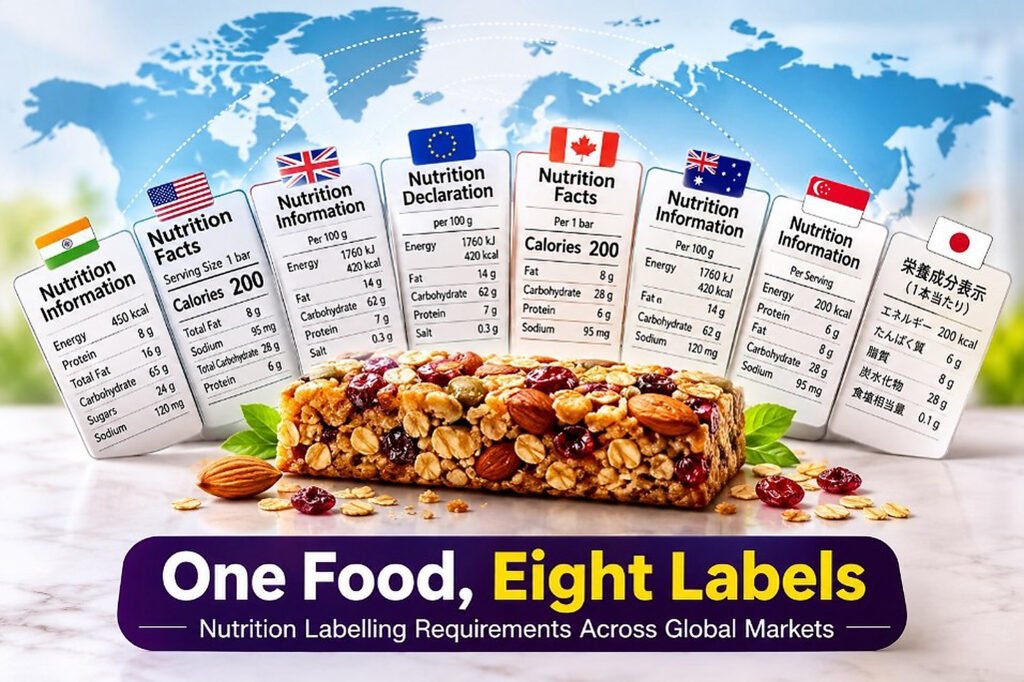
One Food, Eight Labels: Nutrition Labelling Requirements Across Global Markets
Ship the same packet of biscuits to eight markets and you will need eight different nutrition labels. The nutrients listed, the units, the reference values and even the basis (per 100 g or per serving) change at every border. A panel that is perfectly legal in one country can be non-compliant in the next.
The cost of getting it wrong is real: relabelled stock, delayed shipments and rejected imports. For consumers, the same differences explain why one pack shows “salt” and another “sodium”, or why some labels list added sugars and others do not.
This guide compares what each regulator actually requires today, and separates enforceable law from proposals. Start with the four points below, then use the tables to check any market.
Key takeaways
- Added sugars: mandatory in India and the US only.
- Salt vs sodium: the UK, EU and Japan declare salt; India, the US, Canada and Australia/NZ
declare sodium. - Singapore requires a panel only when a claim is made, or for Nutri-Grade beverages, edible fats
and oils, and special purpose foods. - Front-of-pack: Canada’s “high in” symbol is the main mandatory scheme in force (since 1
January 2026). Singapore’s Nutri-Grade mark is mandatory for beverages graded C or D.
Which nutrients must be declared?
The table below shows what each regulator requires in the standard panel, so you can see at a glance where one market’s label will fall short in another.
M = mandatory, C = conditional, V = voluntary, N = not provided for.
| Nutrient | India | USA | UK/EU | Canada | AU/NZ | Singapore | Japan |
|---|---|---|---|---|---|---|---|
| Energy | M (kcal) | M (Calories; kJ optional in brackets) | M (kJ + kcal) | M (Calories) | M (kJ) | C (kcal, kJ or both) | M (kcal) |
| Total fat | M (g) | M (g) | M (g) | M (g) | M (g) | C (g) | M (g) |
| Saturated fat | M* (g) | M (g) | M (g) | M (g) | M (g) | C (g) | V (g) |
| Trans fat | M* (g) | M (g) | N | M (g) | C (g) | C (g) | N |
| Carbohydrate | M (g) | M (g) | M (g) | M (g) | M (g) | C (g) | M (g) |
| Total sugars | M (g) | M (g) | M (g) | M (g) | M (g) | C (g) | V (g) |
| Added sugars | M (g) | M (g) | N | N | N | N | N |
| Fibre | V (g) | M (g) | V (g) | M (g) | C (g) | C (g) | V (g) |
| Protein | M (g) | M (g) | M (g) | M (g) | M (g) | C (g) | M (g) |
| Sodium | M (mg) | M (mg) | N | M (g) | M (mg; mmol optional) | C (mg) | V (mg) |
| Salt | N | N | M (g) | N | N | N | M (g; salt equivalent) |
| Cholesterol | C* (mg) | M (mg) | N | M (g) | C (mg) | C (mg) | V (mg) |
*India: only if total fat exceeds 0.5% (cholesterol also needs animal fat). Singapore “C”: required only when a panel is required or the nutrient is claimed. ‡Japan: sodium (mg) may only appear alongside the required salt equivalent. US, Canada and AU/NZ may omit some items at very low levels.
Units: g = grams, mg = milligrams. Japan’s salt equivalent = sodium (mg) × 2.54 ÷ 1,000. Units were checked against each jurisdiction’s regulations and official guidance. Singapore’s g/mg units come from the Health Promotion Board guide, Japan’s from Consumer Affairs Agency and Tokyo guides (the Japanese Standards were not read), and AU/NZ reflects the October 2024 compilation.
Disclaimer: This table is a summary for general information. Requirements vary by product category, so please check it against the current official texts for your specific product before using it for labelling or compliance decisions.

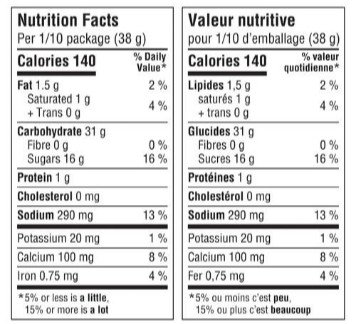
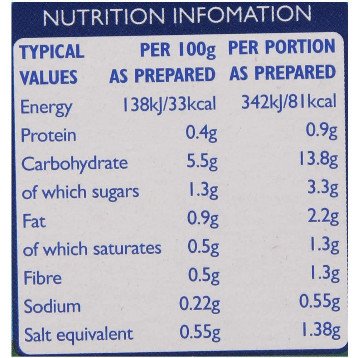
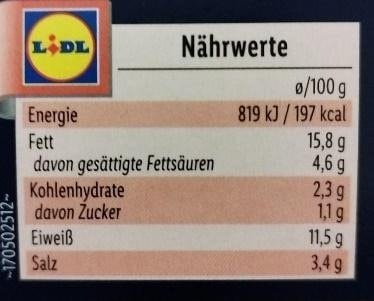
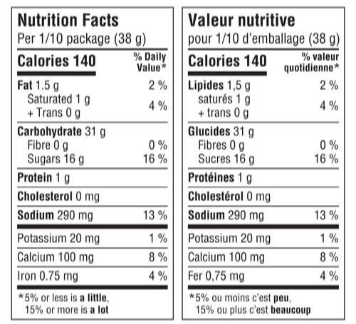
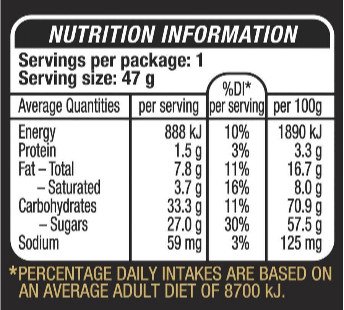
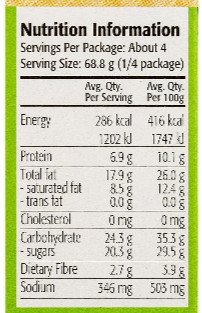
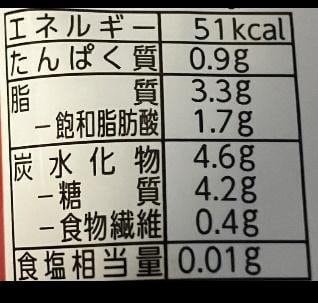
Legend (left to right, top to bottom):
Top row: India; United States; United Kingdom; European Union (Germany).
Bottom row: Canada; Australia/New Zealand; Singapore; Japan.
How are values expressed?
| Market | Reference value | Declaration basis |
|---|---|---|
| India | % RDA per serve (2,000 kcal; 67 g fat; 50 g added sugar; 2,000 mg sodium) | Per 100 g/ml or per pack, plus per serve |
| US | Daily Values (fat 78 g; added sugars 50 g; sodium 2,300 mg) | Per serving (mandatory) |
| UK/EU | Reference Intakes (8,400 kJ; fat 70 g; sugars 90 g; salt 6 g) | Per 100 g/ml (mandatory); per portion optional |
| Canada | Daily Values (fat 75 g; sugars 100 g; sodium 2,300 mg) | Per serving of stated size |
| AU/NZ | None required in the panel | Per serving and per 100 g/ml |
| Singapore | None identified | Per 100 g/ml and/or per serving |
| Japan | None in the standard panel | 100 g, 100 ml, serving or pack |
These reference values are not interchangeable. Each serves a different legal purpose, so never copy one market’s percentages onto another’s label.
Front-of-pack labelling: what is actually in force?
- In force: Canada (“high in” symbol), Singapore (Nutri-Grade for beverages).
- Voluntary: UK colour coding, Australia/NZ Health Star Rating, Japan’s 2026 guidelines, EU schemes.
- Proposed, not law: US “Nutrition Info box”, India warning labels (Supreme Court reserved its order on 28 September 2026), EU harmonised label, a mandatory Health Star Rating.
Practical tips for exporters
- Keep data for every nutrient, including trans-fat, added sugars and cholesterol, and derive salt from sodium per market.
- Check claims early: they trigger extra declarations in Singapore, Canada and the US.
- Never reuse a US panel in Canada, and track pending changes (India’s 2026 amendment, the US front-of-pack rule).