
Cross contamination remains one of the most persistent risks in food operations, but it is also one of the most controllable when approached systematically. The focus is not just on identifying where contamination can occur, but on designing operations in a way that prevents contact between incompatible materials, surfaces, and processes.
As per expectations from the Food Safety and Standards Authority of India, food businesses must implement practical and effective controls to ensure that contaminants do not transfer between raw materials, finished products, equipment, or personnel.
Designing Operations to Prevent Contact
The most effective way to control cross contamination is to eliminate opportunities for contact.
This starts with physical segregation. Raw and ready to eat products must be handled in clearly separated areas. Where complete separation is not possible, processing should be scheduled in a way that minimizes overlap, followed by thorough cleaning before switching operations.
Storage also plays a critical role. Raw materials should always be stored below or away from finished products to prevent accidental drips, spills, or contact.
Controlling Equipment and Utensils
Shared equipment is one of the most common sources of contamination. The preferred approach is to use dedicated equipment for different product categories.
Where this is not feasible, strict cleaning and sanitation protocols must be followed between uses. This includes validated cleaning procedures that ensure removal of both microbiological hazards and allergens.
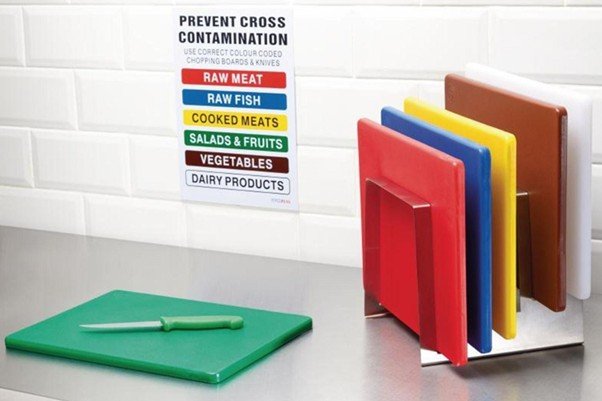
Colour coding systems are widely used to simplify this process. By assigning specific colours to tools for specific uses, the risk of misuse is significantly reduced.
Managing Personnel Practices
Human handling is a critical control point. Even with strong infrastructure, poor personnel practices can compromise the system.
Food handlers must follow strict hygiene practices, including proper handwashing, use of gloves where required, and changing protective clothing when moving between different processing areas. Movement of personnel should be controlled to avoid unnecessary crossover between raw and finished product zones.
Regular training ensures that employees understand not just what to do, but why it matters.
Cleaning as a Preventive Tool
Cleaning is not just a routine activity, but a key preventive control.
Food contact surfaces, equipment, and work areas must be cleaned at defined intervals and between operations. The effectiveness of cleaning should be monitored through inspections and, where required, testing methods.
Improper or incomplete cleaning can spread contamination rather than eliminate it, making this step critical.
Strengthening the System
To ensure that controls are consistently followed, food businesses should:
- Define clear workflows that prevent cross movement of materials and personnel
- Implement the process as per the workflow
- Monitor critical practices through supervision and internal checks
- Maintain records of cleaning, sanitation, and process controls
- Periodically review systems to identify gaps and areas for improvement
Final Perspective
Preventing cross contamination is about control, consistency, and clarity in operations. When processes are well designed and practices are consistently followed, the risk reduces significantly.
A structured approach not only ensures compliance with regulatory requirements but also protects product quality and consumer safety at every stage of the food chain.