
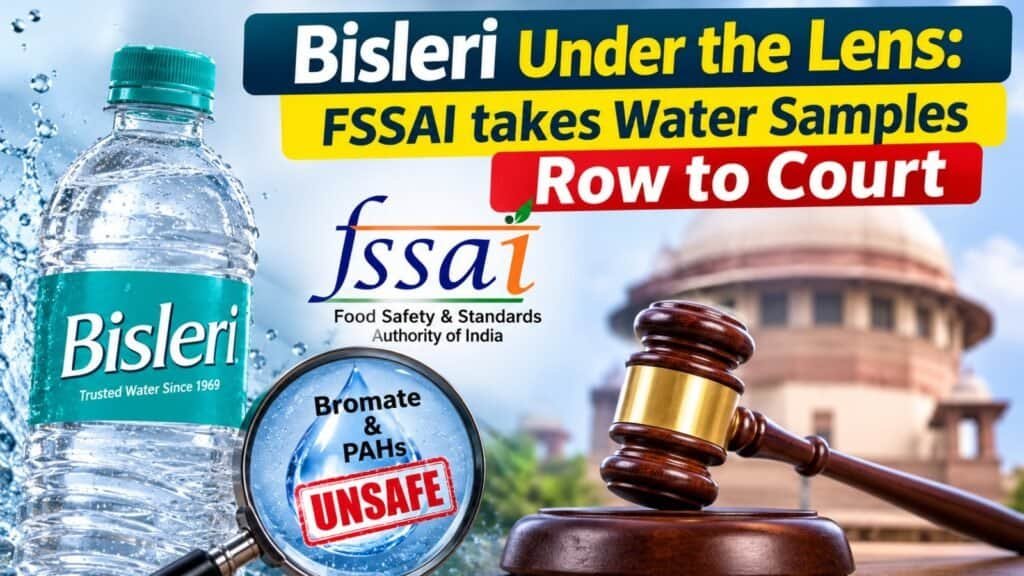
The Food Safety & Standards Authority of India (FSSAI) has sanctioned prosecution against Bisleri International Pvt Ltd. After a regulatory sample of its packaged drinking water was declared unsafe under the Food safety & standard (FSS) Act, 2006. Bisleri, one of India’s widely known bottled water brands, says its water is safe and that it will cooperate with the regulator.
What Happened?
FSSAI said a sample of “Packaged Drinking Water (other than Mineral Water)”, taken from Bisleri’s premises, failed the prescribed limit for bromate and was declared unsafe under the Food Safety and Standards (FSS) Act, 2006.
Bisleri appealed, so the sample was sent to a referral food laboratory. FSSAI says this lab also found the sample unsafe, after detecting polynuclear aromatic hydrocarbons (PAHs). On the basis of both results, FSSAI sanctioned prosecution. This is permission to begin legal proceedings. It is not a court verdict.
Bisleri Say’s
In a statement on 23 November, Bisleri said drinking water safety is a priority and its water is safe to drink. The company says the case relates to a batch made in September 2025 at its Goa plant, one of 143 plants. Its account of the timeline is:
- 30 September 2025: FSSAI collected six samples. Five met all standards. The sixth showed bromate at 12 micrograms per litre (µg/L), against a limit of 10 µg/L.
- 22 November 2025: Bisleri appealed. It says the referral lab found bromate within the limit but flagged PAHs.
- Independent test: Bisleri had the same sample tested at an FSSAI-approved lab, which found bromate within the limit. It sent the report to FSSAI’s Western Regional Office on 2 February 2026.
- Since then: The company says it heard nothing further and has received no notice, so it believed the matter was closed.
Bisleri also says it runs over 90 quality checks across a 10-step manufacturing process.
Where the Two Accounts Differ
- Referral lab result: FSSAI says the referral lab declared the sample unsafe because of PAHs. Bisleri says that lab found bromate within the limit but flagged PAHs.
- Bromate: FSSAI says the sample exceeded the bromate limit. Bisleri says its independent test found bromate within the limit.
- Notice: FSSAI has sanctioned prosecution. Bisleri says it has received no notice.
These differences are likely to be examined in the legal proceedings.
What Are Bromate and PAHs?
Bromate is not normally found in source water. It can form when ozone, used to disinfect water, reacts with naturally occurring bromide. How much forms depends on factors such as the bromide in the source water, the ozone dose and the pH, and it is difficult to remove once formed, so control of the disinfection process matters.
The WHO drinking-water guidelines give a provisional limit of 10 µg/L. In India, FSSAI’s standard for packaged drinking water sets the same maximum for bromate: 0.01 mg/L (10 µg/L).WHO’s cancer agency, IARC, classes bromate as possibly carcinogenic to humans (Group 2B), based mainly on animal studies. Health concerns mainly relate to long-term exposure at high levels. People with existing kidney conditions may be at greater risk.
PAHs are pollutants that form when fuels and other organic material are burned. They are found in vehicle exhaust, industrial emissions and tobacco smoke, and can reach packaged water through contaminated source water, weak treatment controls, or contaminated storage and packaging. FSSAI’s packaged drinking water standard lists PAHs as “not detectable” in toxic-substance parameters. Not every PAH is cancer-causing. The risk depends on which compounds are present and how much exposure there is.
What Food Businesses Should Do
- Monitor bromate if you use ozone disinfection, and check bromide levels in your source water
- Review source water, treatment, storage and packaging for possible PAH contamination
- Test regularly at accredited laboratories and keep batch-wise records
- Keep samples or retained stock for retesting, in case a result is challenged
- Keep a full record of appeals, retests and letters with FSSAI, and check its notices regularly
Conclusion
The situation has left consumers confused and uncertain due to conflicting reports, delays in regulatory action and a lack of clear communication. It highlights the need for a stronger food safety system, including uniform testing standards, regular laboratory proficiency testing, timely investigation, clear recall procedures and transparent communication with the public.
Until further clarity is provided by the authorities, consumers should avoid unnecessary panic, purchase products from trusted sources, check batch details and follow official FSSAI updates.
Ultimately, consumer safety, timely action and public trust should remain the top priorities.