
The Role of Indicators in Enhancing Product Safety and Quality
1/3rd of the food produced globally is lost or wasted annually. Smart packaging thus offers a new approach to reducing food waste and loss. Not only protecting food from the environment it also extends the shelf life and holds promise for brand objectives like traceability, recyclability, consumer engagement, and supply chain logistics.
The four primary purposes of traditional packaging are preservation and protection (Protect food against Heat, Light, Smell, Microbial and Chemical Contamination, Insects, Dirt, and Dust, etc.), Convenience (ready-to-eat foods that are simple to handle, like resealable containers that are microwave-safe), Containment (available in a variety of sizes and shapes), and Communication (providing information like the brand logo, a list of nutrients, a list of ingredients, a price, preparation guidelines, an expiration date, etc.).
Although new demands like population growth, changes in consumer behaviour and manufacturing techniques, as well as environmental consciousness and emerging technologies like nanotechnology and biotechnology, served as the catalyst for the development of smart food packaging.
Active and intelligent packaging are two different concepts of smart packaging.
Active packaging incorporates intentional components that release or absorb substances into or from the packaged food or its surrounding environment to improve product shelf life or quality. These systems fall into two categories: releasing or absorbing, such as carbon dioxide scavengers, oxygen scavengers, ethanol emitters, ethylene scavengers, antimicrobial agents, and antioxidant releasers.
The active package interacts with the food inside and helps to improve the shelf life. A great example is the increased shelf life of beer from three to six months by adding oxygen absorbers to the cap of the bottle.
Intelligent packaging is a packaging system that uses the internal or external package environment as “information” to monitor the status of product quality, track the product, and identify the hazards during transportation and storage.
On the other hand, Intelligent packaging does not affect the food. Intelligent packaging uses indicators, sensors, and data carriers to monitor the condition of food, representing the future of packaging. We will discuss these components in more detail shortly. Let’s discuss the Indicators a little more in detail.
Indicators
An indicator is a type of intelligent packaging that sends information about the presence or absence of a particular substance, whether a reaction is occurring, and the substance’s concentration. Time-temperature indicators, Freshness indicators, and Gas indicators are the three broad categories for indicators.
Time Temperature Indicator(TTI)
Temperature significantly affects the shelf life of food products, especially perishable items. A time-temperature indicator provides a visual summary of temperature changes and is primarily used for temperature-sensitive foods, such as chilled and frozen products.
2 main types of TTI are:
- A partial temperature indicator only responds when the predetermined threshold temperature is exceeded.
- Full history indicators (Which respond continuously to all temperatures).
VITSAB TTI
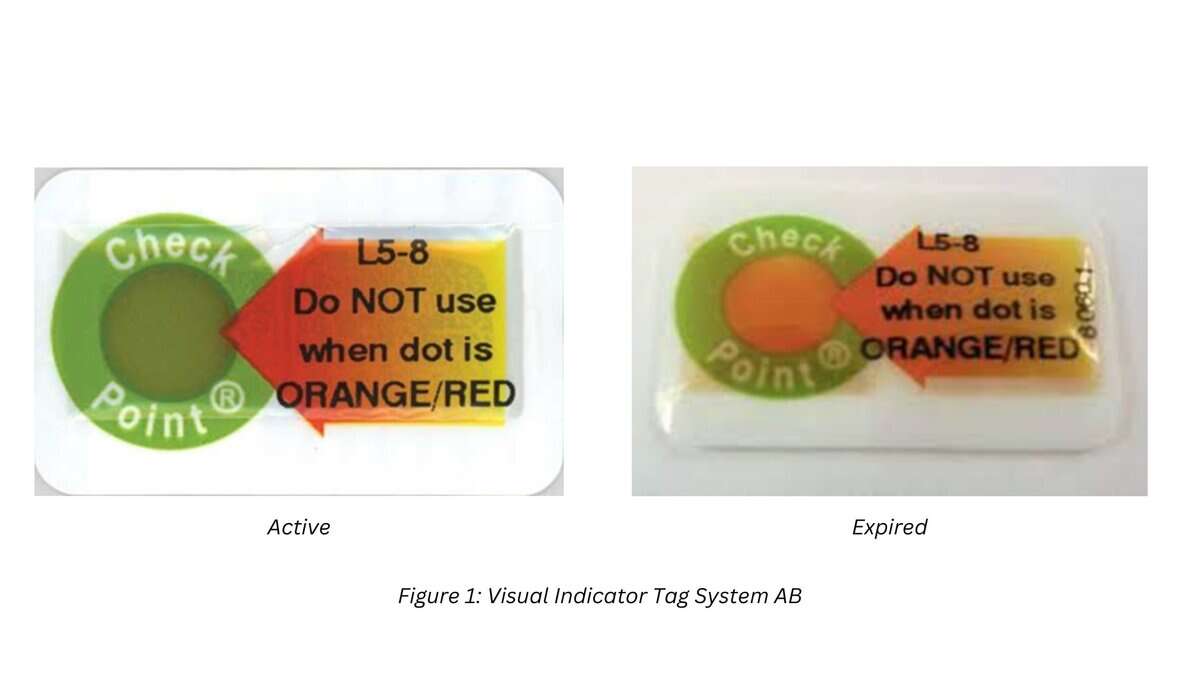
A Swedish research and development company named Vitsab International AB created labels calibrated to reflect bacteria growth and adhere to temperature monitoring rules. The spotlight progressively shifts from green to red if there are any temperature variations.
This is another one which is available from 3M Monitor Mark. This diffusion-based indicator label changes color when an oxidizable chemical system is exposed to air, with the color change controlled by the amount of air passing through a film. A blue-colored fatty acid ester diffuses along a wick to trigger the reaction. The indicator’s response is measured by the movement of the blue dye along the track and is complete when all five windows turn blue.
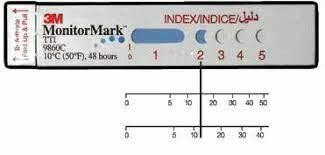
Figure 2: 3 M Monitor mark
Freshness indicators
- They are intelligent devices that allow the monitoring of the quality of food products and indicate spoilage or freshness of the packaged product through colour changes directly detected by the naked eye.
- Freshness indicators are based on the use of dyes sensitive to pH variations caused by the deterioration of the product, which leads to a visible change in the colour of the indicator.
Food Fresh
The Vanprob company created Food Fresh™ indicators, a class of timers that can be adjusted to expire within a specified ‘consume within’ time limit, ranging from a few days to several weeks or months. They are a practical remedy for the issue of food storage following opening.
A label applicator can be used to apply the food fresh sign, which is shown in Fig 3., to products such as jars, vacuum-packaged items, or cartons. The PET labels are less than 50 microns thick and constructed of PET.
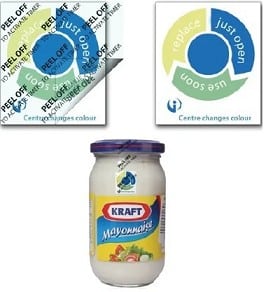
Figure 3: Food fresh indicator
RipeSense
Many fruits do not show visible signs of ripening, due to which, the customers find it difficult to recognize whether the fruit has reached its preferred state of ripeness or not. The ripe sense will eliminate this barrier and also help in reducing food waste. The pack comes with a colour-changing sensor spot, which shows exactly how ripe the fruit is.
The RipeSense is the first intelligent sensor label that works by reacting to aromas released by the fruit, indicating the ripeness of the fruit. The sensor is initially red and graduates to orange and finally turns to yellow. This allows the customers to choose the fruit based on maturity. The recyclable ripeSense® pack provides improved hygiene security as it protects the fruit from being handled or squeezed by other shoppers.
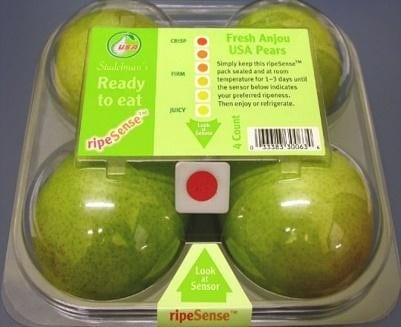
Figure 4: RipeSense
Gas indicators:
For use in polymeric films for packaging systems, a chemical dye-based visual carbon dioxide indicator is being developed. In addition to providing information on the CO2 levels inside the packaging, this non-destructive film can help spot early spoiling. No matter the temperature, the system is based on a pH-dependent color shift. The indicator’s colour changes as a result of changes in pH brought on by variations in CO2 concentration.
The gas composition in the package headspace can alter because of the gas produced by lipid oxidation and microbiological deterioration. Gas indicators can therefore track gaseous changes and alert consumers to the safety and quality of food goods. These indications can be printed on packing films or presented as labels.
These indicators change color through chemical or enzymatic reactions, showing the presence or absence of oxygen or carbon dioxide. Gas indicators are usually printed or immobilized inside the package to directly contact the gases produced during spoilage. Modified atmosphere packaging (MAP) replaces the air in a pack with a fixed gas mixture, without further control during storage. Since MAP mainly involves oxygen and carbon dioxide, gas indicators help maintain a controlled environment by continuously monitoring the gas composition
Conclusion
Smart packaging offers a sustainable solution to increase the functionality of product packaging to serve a variety of different demands. Its benefits are pretty evident. Several clever packaging methods have developed during the past few years. Including these technologies in food packaging provides valuable information about the product, extends shelf life, and enhances quality. Researchers still need to conduct further studies on intelligent packaging materials to develop more affordable and user-friendly solutions.
Although most customers say they are willing to pay more for higher quality and better product information, they rarely do. Educating consumers about the benefits of intelligent packaging could increase their willingness to pay a premium. Additionally, boosting consumer confidence in the safety and reliability of these systems is essential. Companies should actively promote these technologies and recognize that intelligent packaging can offer a genuine competitive advantage. Overcoming these challenges would enable a broader adoption of intelligent packaging.
How can we help?
Are you having trouble deciding which smart packaging is ideal for your product? We are able to assist you with that. We, as your trusted partner, will provide expert guidance and support in selecting the most suitable intelligent packaging indicators for your product.