

International Organization for Standardization (ISO) has published the 2025 version of the entire ISO 22002 series, the backbone of prerequisite programmes (PRPs) for ISO 22000 and FSSC 22000. At the heart of this update is the new ISO 22002 100:2025, a common foundation designed to harmonize PRPs across the entire food chain and the much-awaited ISO 22002 7:2025 – Retail & Wholesale.
What’s Been Released?
Updated PRP Standards
• ISO 22002 1:2025 – Food Manufacturing
• ISO 22002 2:2025 – Catering
• ISO 22002 4:2025 – Food Packaging Manufacturing
• ISO 22002 5:2025 – Transport & Storage
• ISO 22002 6:2025 – Feed & Animal Food Production
• ISO 22002 7:2025 – Retail & Wholesale
New Addition
• ISO 22002 100:2025 – Common Requirements for All Sectors of the Food Chain → A single, unified PRP baseline for all sectors, streamlining requirements and removing duplication.
• ISO 22002 7:2025 – Retail & Wholesale
Reviewed & Confirmed
• ISO 22002 3:2011 – Farming (remains valid, unchanged)

Why ISO 22002 100 Matters
For years, each sector specific PRP standard repeated the same hygiene, documentation, and risk control clauses, written slightly differently. ISO 22002 100 ends that duplication.
How?
• One Common Core: All shared PRP requirements (hygiene, allergen management, supplier controls, traceability, food defense) now live in Part 100.
• Sector Specific Layers: Each Part 1 7 simply references Part 100 and adds what’s unique to that industry.
What this means:
Cleaner Documentation – You write the common SOPs once, then build sector-specific add-ons. Easier Training – Teams learn one PRP foundation, then sector-specific rules. Consistent Audits – Shared expectations across food manufacturing, catering, packaging, retail, feed, and transport.
Strategic Implications
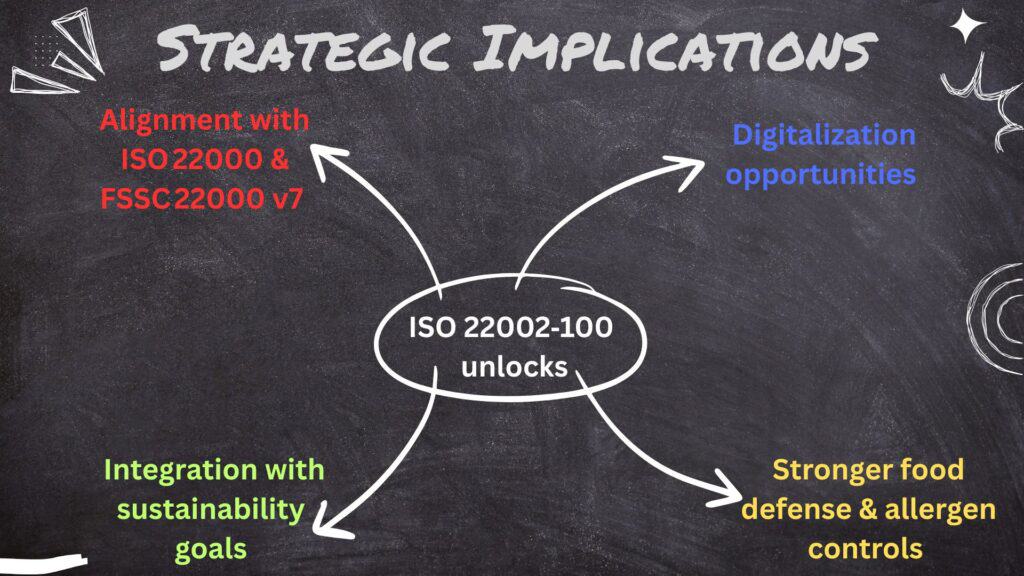
This is more than an editorial tidy-up. ISO 22002 100 unlocks:
• Alignment with ISO 22000 & FSSC 22000 v7 (coming soon)
• Integration with sustainability goals (circular packaging, responsible sourcing)
• Digitalization opportunities (traceability, IoT enabled hygiene monitoring)
• Stronger food defense & allergen controls – easier to enforce across multiple operations
For FSSC 22000 certified organizations, this structure means your next audit will look different. Your PRP system will need to map to ISO 22002-100 plus your sector-specific module.
What Should Organizations Do Now?
Clause 6.3 of ISO 22000:2018 – Planning of Changes – is your roadmap.
Here’s the transition checklist:
- Gap Analysis: Map your existing PRPs against ISO 22002 100 and sector-specific changes.
- Update Documentation: Consolidate shared PRPs into a single Part 100 reference; adjust SOPs.
- Train Teams: Deliver foundational ISO 22002 100 sessions before diving into sector modules.
- Assign Responsibilities: Nominate leads for common PRPs versus sector specific compliance.
- Set Timelines: Plan implementation, internal verification, and audit readiness checkpoints.
Credits for the article

Pankaj Chettri
QHSE & Food Safety Director | FMCG & Beverage | ISO 22000, FSSC 22000, HACCP | ESG & Sustainability | Driving Compliance, Safety & Growth Across UAE | KSA | GCC
My Perspective as a QHSE Leader
In 20+ years leading quality, safety, and sustainability across food & beverage giants, I’ve seen how standards evolve.
This isn’t a “paperwork update.” It’s a chance to: Strengthen food safety culture across all functions, Simplify systems without weakening rigor, Prepare for a future where compliance is digital, integrated, and sustainability driven
The leaders who start now – who do the gap analysis, streamline SOPs, train their teams – won’t just pass audits. They’ll set the benchmark. ISO 22002:2025 is the boldest step in a decade toward safer, smarter, more aligned food systems.
