

Why the Industry needed a Prerequisite Programs – PRP Overhaul
For over a decade, the ISO/TS 22002 series provided the backbone and a baseline for Prerequisite Programs (PRPs) across Food Manufacturing, Catering Facilities, Food Packaging Manufacturing, and Animal Feed Production sectors.
Over the last 15 years, the food industry has transformed significantly. This transformation has been driven by several factors, including globalization, the emergence of new risks, changing consumer demands, and evolving regulatory expectations. The ISO/TS 22002 series, in its current form, has become increasingly fragmented and outdated.
Here’s why an overhaul was long overdue:
- Fragmented Structure: Sector-specific standards have led to duplication, overlaps, and inconsistencies.
- Critical Gaps: The standards don’t adequately address food fraud, food defense, sustainability, or digital traceability.
- Lack of Alignment: Not aligned with the 2023 Codex HACCP revision or modern FSMS principles.
- Limited Scalability: Challenging to apply across multi-sector or global supply chain operations
In today’s risk-sensitive environment, these legacy standards can no longer support the level of food safety resilience and transparency the industry demands.
ISO/TS 22002 Series – Prerequisite Programmes on Food Safety

New Unified Foundation (ISO 22002-100: 2025)

What’s Happening Now?
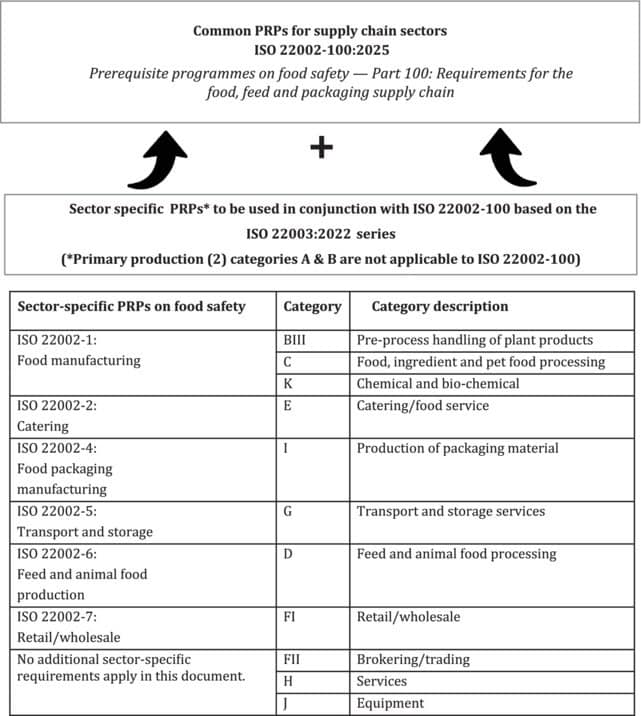
- Specifically, ISO 22002-100:2025 will serve as the new foundational PRP, merging and streamlining many of the earlier versions.
- Meanwhile, sector-specific needs (such as Packaging, Catering, Feed, and Farming) will continue as add-on parts (e.g., 1 -7) but must now be used in conjunction with Part 100.
- This structure enables greater clarity, consistency, and cross-sector application for companies operating in multiple segments of the supply chain.
ISO 22002‑100:2025 – What’s New & Why It Matters

What This Means for Industry & Supply Chains
- Audit Landscape Simplified: One PRP core, plus minor add-ons – less duplication, more clarity.
- Modern Risk Management: Integrated food defense / fraud, supplier controls, and sustainability equal resilience.
- Next-level Hygiene Practices: Clearer control of zones, systems, and sanitation validation.
- Supply Chain Transparency: Tighter traceability and accountability for outsourced/third-party inputs.
- Compliance Timeline: Official launch July 2025.
How to Position Your Organization for a Smooth Transition
- Gap Assessment: Map your current PRPs (legacy systems) to the ISO 22002‑100 framework.
- Revamp Documentation: Merge existing SOPs into unified structure; update Hygiene, Supplier, and Defense protocols.
- Train Teams: Carry out targeted workshops on new areas like Food Fraud, Defense, sustainability, and the CODEX alignment.
- Supplier Engagement: Update onboarding criteria, monitoring, and traceability for upstream partners.
- Audit Integration: Align internal and external audits with the new structure – use Part 100 as audit backbone.
- Share readiness: Boost stakeholder confidence, customers, certification bodies, and regulators by proactively communicating your transition timeline.
Final Take: Embrace the Change Now

ISO 22002‑100:2025 is a strategic upgrade, not a bureaucratic tweak. It redefines how we manage food safety PRPs – making them holistic, preventive, and aligned with modern risks and values. The message is clear: Organizations that adapt early will shape tomorrow’s FSMS norms. Those that delay risk compliance gaps, operational inefficiencies, and weakened stakeholder trust.

Pankaj Chettri
QHSE & Food Safety Director | FMCG & Beverage | ISO 22000, FSSC 22000, HACCP | ESG & Sustainability | Driving Compliance, Safety & Growth Across UAE | KSA | GCC