
Charles Caleb Colton once said, “There are some frauds so well conducted that it would be stupidity not to be deceived by them.” Fraudsters often target food supply chains, which remain among the most vulnerable sectors. Experts estimate that food fraud costs the global industry between US$30 to 40 billion each year.
What is Food Fraud?
The term ‘Food Fraud’ started coming to light after the infamous ‘Melamine Incident’ in China in 2008, where infant formulas were intentionally contaminated with Melamine. This caused around 300,000 infants and young children to suffer from kidney and urinary infections with 6 reported deaths.
Food fraud comprises of Economically Motivated Adulteration (EMA), grey Market and counterfeiting. It can have various forms but mainly involves mislabeling or misbranding of products, intentional adulteration, and substitution of food products. It can occur at any stage of the supply chain—from farm to fork. The main motive is usually financial gain. Offenders aim to reduce processing costs, boost sales, or gain an edge over competitors. In some cases, It is driven by social or political motives as well.
Rising demand for certain foods and the global, complex supply chain create opportunities for fraudsters. Challenges in traceability and authenticity make food fraud easier to commit.

Figure 1: Types of Food Frauds ( Source: Food Fraud | Knowledge for policy (europa.eu) )
How Does Food Fraud Affect Consumers and Food Industries?
Consumers get misled into buying products that are not what they claim to be in terms of quality, ingredients, and food safety. These products can have adverse impacts on consumers’ health and destroy trust in the food industry. It can become a critical food safety issue by exposing consumers to hazardous substances.
Food companies also suffer significantly from such fraud with a damaged reputation, legal complications, and loss of potential revenue.
Common Products Susceptible to Food Frauds and Prominent Incidents:
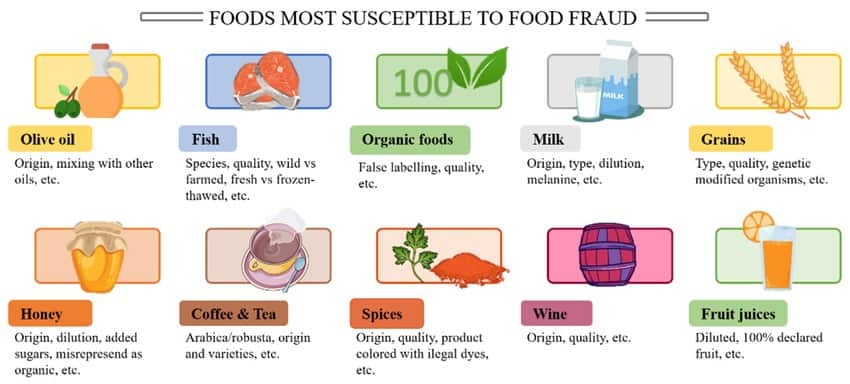
Figure 2: Common Food Products Prone to Food Fraud ( Source: Some of the foods most susceptible to food fraud. | Download Scientific Diagram (researchgate.net) )
- Spanish Oil Incident, 1981: Fraudsters sold industrial rapeseed oil contaminated with toxic aniline as “Pure Olive Oil,” leading to over 1,000 deaths from Toxic Oil Syndrome.
- Horsemeat Scandal, UK, 2013: Frozen beef burgers in the UK and Ireland tested positive for horse DNA, causing no safety risk but a €360M market loss and a 43% drop in frozen burger sales.
- American Peanut Incident, 2009: A company knowingly sold salmonella-contaminated peanut butter, resulting in 7 deaths and hundreds of illnesses—marking the first U.S. food safety felony conviction.
- Canadian Honey Laundering, 2018: Importers mislabeled Chinese honey as Canadian and adulterated it with banned antibiotics, damaging local honey producers.
- The Great Wine Fraud, 2000s: A con artist sold fake high-end wines at auctions for over 12 years, scamming buyers out of $35M—one of the longest in U.S. history.
The incidents mentioned above-raised concerns over regulatory authorities and enforcement, testing parameters and surveillance systems.
Preventive Measures for Food Fraud:
In light of the above, it becomes imperative for entities spread across the supply chain to take measures to arrest such incidences of food fraud. A robust FSMS system can aid.

Figure 3: Food Protection Umbrella ( Source: VACCP Food Fraud Plan | TACCP Food Defence | Food Safety Management (tqcsi.com) )
- Food Fraud Vulnerability Assessment: VACCP (Vulnerability Assessment Critical Control Point) is part of the broader Food Safety umbrella, along with HACCP (Hazard Analysis Critical Control Point) and TACCP (Threat Analysis Critical Control Point). While HACCP focuses on food safety hazards, VACCP and TACCP focus on vulnerabilities and threats in the food chain. VACCP assesses points where the supply chain is vulnerable to food fraud. TACCP focuses on threats like food sabotage or intentional contamination. Both VACCP and TACCP follow a similar approach to HACCP but are designed specifically to prevent food fraud incidents.
- Food Safety Management System (FSMS): The food safety Management System plays a crucial role in combating food fraud. The FSMS includes supplier verification, traceability system and product testing for authenticity purposes. Additionally, it aids to create a food safety culture within a company. Implementation of such management systems gives food businesses a well-structured plan to assess vulnerabilities with corrective action planning and implementation.
- Analytical Methods & Testing Technologies:
Emerging testing technologies—including DNA testing, chemical analysis, and spectroscopy—help prevent food fraud. These methods detect adulteration or substitution by analyzing a product’s DNA or chemical composition and comparing it against Certified Reference Material (CRM). Experts typically use this technology to verify a product’s geographical origin, confirm its species, and ensure its authenticity. - Blockchain for Food Supply Chain: Using blockchain in the food supply chain can significantly help prevent food fraud. Blockchain allows every authorized person in the supply chain to access secure, tamper-proof data. Once entered, the data cannot be altered. This system provides real-time traceability and ensures transparency at every stage. It also enables secure data transfer and helps prevent unauthorized movement of products.
Conclusion:
Food fraud is a serious and growing threat to the global food supply chain. It is increasing rapidly due to globalization, rising demand for specific food products, and weak traceability and authenticity systems. It can lead to major food safety risks and disrupt the entire food industry ecosystem. Preventive measures like VACCP studies and Food Safety Management Systems (FSMS) help combat food fraud. Analytical tools and AI-based methods also offer practical ways to detect and prevent fraud. It should be treated with the same urgency as food safety issues. It affects behavioral, social, economic, and health aspects—causing widespread harm across the supply chain.
How can we help?
We, as your trusted partner, can help you analyze vulnerabilities and threats in your processing line. We assist you in planning and implementing effective mitigation strategies. Our team also offers consultancy for deploying Food Safety Management Systems (FSMS) such as FSSC 22000, BRC, ISO 22000, and IFS at your premises.