

Introduction
The coconut palm (Cocos nucifera), often called the “tree of life,” is celebrated for its versatility and cultural importance. In India, it is revered as the Kalpavriksha, a divine tree that provides sustenance, shelter, and livelihood. Evidence points to dual domestication—the Pacific type spread by Austronesian seafarers and the Indo-Atlantic type cultivated on the Indian subcontinent over 2,000 years ago. By the 1st century BCE, coconuts were already mentioned in Sanskrit epics and noted in foreign accounts. Coconut oil production contributes significantly to rural livelihoods and export earnings, while ecologically the palms prevent coastal erosion and enhance soil stability. Culturally, they remain central to rituals, cuisine, and festivals across the country.
India today ranks among the world’s leading producers, with Kerala’s Thrissur, Palakkad, Kozhikode, Malappuram, Alappuzha, and Kollam districts forming the traditional coconut belt, and Karnataka’s Tiptur in Tumakuru, Chitradurga, Hassan, Dakshina Kannada, and Udupi serving as major hubs—Tiptur being renowned as the “coconut capital” for its high-yielding plantations. These regions cultivate hardy tall varieties such as West Coast Tall, prized for copra and oil, alongside improved dwarf and hybrid types like Chowghat Orange Dwarf, Kalpasree, and Malayan Green Dwarf, valued for tender nut water, early bearing, and disease resistance. To support this vital sector, the Government of India established the Coconut Development Board, which oversees integrated growth of cultivation and industry nationwide.

Beyond subsistence, coconut gained global economic significance with the commercialization of coconut oil in the 19th century, though its prominence declined as other vegetable oils rose in prominence. Even so, it remains central to traditional diets, agroforestry practices, and industries such as cosmetics, wellness, and natural foods. Its tall and dwarf varieties offer diversity in yield, stature, and adaptability. At the same time, its products range from coconut water and cream to coir fiber, timber, and ornamental uses —underscoring its enduring role as India’s “tree of life”.
Ecologically, coconut palms stabilize coasts, withstand cyclonic winds, and thrive in warm, humid climates with well-drained soils. They are compatible with intercropping systems, supporting crops like cocoa, coffee, and taro, and even livestock grazing. Despite challenges like pests, diseases, and market fluctuations, the coconut continues to symbolize abundance, sustainability, and cultural heritage, making it one of the world’s most useful plants.
Market Trends
The global coconut-based products market is expanding quickly because people everywhere prefer natural and eco‑friendly options. This has led to a wide variety of items such as coconut oil, milk, water, flour, sugar, skincare creams, shampoos, biofuels, coir goods, and eco‑friendly packaging, showing how versatile the coconut truly is.
At the same time, producing nations face challenges like weak supply chains, aging plantations that lower productivity, pests and diseases that damage crops, and climate change impacts such as storms and unpredictable rainfall. These issues affect farmers’ incomes and national economies, making it important to modernize farming, strengthen distribution, and adopt sustainable practices to meet rising demand while ensuring long‑term stability.
Nutritional value
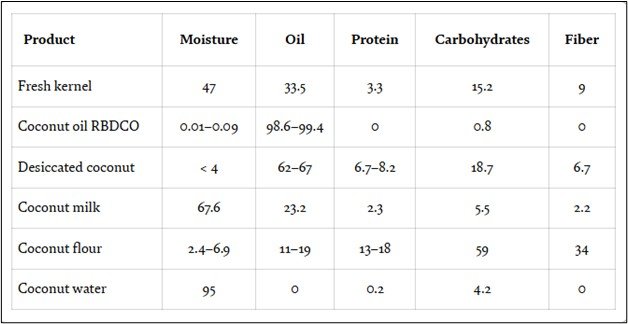
Fresh coconut kernel is nutrient-rich, providing healthy fats, protein, and fiber that support energy and digestion, while coconut oil is valued for its medium-chain fatty acids that boost metabolism and are widely used in cooking and skincare. Desiccated coconut offers concentrated nutrition with high energy and fiber, making it useful in baking and confectionery. Coconut milk, derived from the kernel, is creamy and packed with fats and minerals, serving as a dairy alternative in many cuisines. Coconut flour is gluten-free, high in fiber, and a good option for healthy baking. Coconut water, on the other hand, is light, refreshing, and naturally rich in electrolytes like potassium, making it an excellent hydrating drink. Together, these products showcase the coconut’s versatility as both a nourishing food and a functional ingredient across diets and industries.
Coconut: Nutritional and Industrial Significance
Table 1. Average percent composition of the major constituents in coconut foods
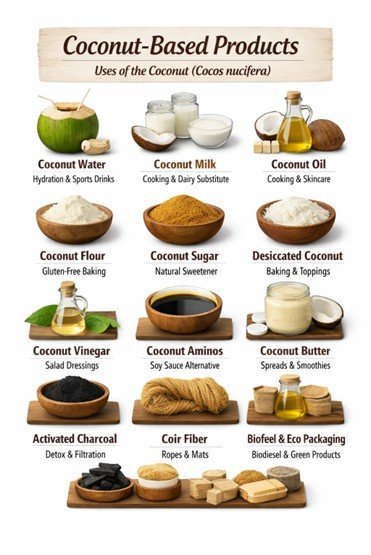
Categories of Coconut-Based Products
- Food and Beverages
Coconut is widely used in the culinary world, offering products such as sugar, flour, milk, water, and oil. Each of these has distinct nutritional benefits and versatile applications. Coconut oil is valued for cooking and frying, while coconut milk and water serve as refreshing drinks and dairy alternatives. Coconut flour and sugar enrich baked goods and snacks, adding texture and flavor while catering to gluten-free and vegan diets. - Cosmetics and Skincare
Thanks to its hydrating and anti-inflammatory properties, coconut oil is a staple in personal care. It is found in moisturizers, hair oils, soaps, and other skincare products, enhancing both nourishment and protection. This category highlights the diverse range of cosmetic items derived from coconut oil. - Industrial Applications
Beyond food and beauty, coconuts play a role in sustainable industries. They are used in producing biofuels, coir-based goods, and eco-friendly packaging materials. These innovations not only expand coconut’s utility but also contribute to environmental sustainability.
Value-Added Coconut Products
Coconut and its by-products are transformed into innovative, dairy-free, and shelf-stable items that meet modern consumer needs. Below are some popular examples:
Coconut Water Concentrate – A stable form of coconut water created through evaporation or freeze-drying. It is rehydrated before use and added to beverages and food products.
- Flavored Coconut Water – Coconut water infused with fruit extracts or essences, offering variety in taste while retaining hydration benefits.
- Coconut Milk Yogurt – A dairy-free yogurt made by fermenting coconut milk with live cultures, suitable for vegans and those with lactose intolerance.
- Coconut Cream Ice Cream – A creamy, dairy-free ice cream made from coconut cream, often sweetened naturally with coconut sugar.
- Coconut-Based Cheese – Plant-based cheese alternatives crafted from coconut oil and milk, designed to mimic the texture and meltability of dairy cheese.
- Coconut Protein Powder – Coconut protein powder is produced from the waste left during virgin coconut oil processing. Fresh coconut milk is treated with enzymes to break down its emulsion, then centrifuged to separate cream, skim milk, and solid protein. The protein fraction is spray-dried into a fine powder. It is high in protein, low in fat, and has good emulsifying and water-retention properties, making it useful in food formulations and as a dietary supplement.
- Neera – Neera is the unfermented sweet sap tapped from young coconut inflorescences. It is a natural, non-alcoholic drink rich in sugars, vitamins, and minerals. To prevent fermentation, lime is often added during collection. Neera is consumed fresh as a health beverage and is valued for its nutritional benefits.
- Toddy – Toddy is the fermented version of coconut sap. Once collected, natural bacteria and fungi quickly ferment the sap, producing an alcoholic drink with about 4–6% alcohol content. Toddy has a short shelf life (must be consumed within hours) and is traditionally enjoyed in many tropical regions. Distilled toddy can be made into stronger spirits like coconut arrack.
Conclusion
Coconut is one of the most versatile natural resources, offering nutrition, health benefits, and industrial applications from nearly every part of the tree. Its kernel, water, milk, oil, flour, and sugar provide energy, hydration, and functional ingredients for food and beverages. At the same time, coconut by-products like coir, charcoal, and shells contribute to sustainable solutions in packaging, purification, and biofuel. The growing demand for natural, eco‑friendly products highlights coconut’s importance not only as a staple food but also as a driver of innovation in health, wellness, and industry. In essence, the coconut is both a nourishing food and a sustainable resource, making it invaluable to communities and economies worldwide.