

Food is any nutritional substance consumed by living organisms to obtain energy, promote growth &
maintain physiological functions. Poisoning refers to harmful effects produced when the body is exposed to
a toxic substance through ingestion, inhalation, skin contact or injection. The severity depends on the toxin’s
natural dose & route of exposure. Foodborne illness is caused by consuming food or beverages
contaminated with pathogenic microorganisms (Bacteria, Viruses, Parasites), their toxic by-products or
harmful chemicals contamination may occur at any point along the food chain, from production &
processing through to final preparation.
Food gets contaminated due to 3 majors hazard categories: Biological, Chemical & Physical, from which
chemical toxins and biological means leads to food poisoning each with distinct risk profiles, mechanism of
harm & control strategies.
Key Risk Factors of Food Poisoning
Temperature Abuse
Temperature is the single most critical factor in bacterial proliferation. The temperature danger zone of
5°C – 60°C is where most food borne pathogens multiply rapidly. Key risks include leaving cooked food at
room temperature for more than 2 hours, refrigerators held above 4°C, thawing frozen food at room
temperature & inadequate reheating of leftovers.
Cross-Contamination
Cross-contamination the transfer of harmful microorganisms from one food, surface or person to another is
one of the most common pathways of foodborne illness. Key forms include direct contamination (Raw meat
touching ready-to-eat food), indirect contamination (Shared utensils without sanitising) & drip
contamination (Raw Meat juices dripping onto foods below in the refrigerator).
Poor Personal Hygiene
Food handlers are a major vector for foodborne illness. Staphylococcus aureus colonises the skin & nasal
passages of approximately 30% of healthy adults & norovirus is shed in stool even after symptoms resolve
high risk behaviours include failing to wash hands, handling food while ill & touching the face or hair
during food preparation.
Inadequate Cooking & Storage
Most vegetative bacteria are destroyed at internal temperature above 75°C. Critical risks include poultry
served pink at the bone, ground meat served medium – rare (E. coli 0157:H7 is mixed throughout during
grinding) & microwave cold spots harbouring live pathogens. Poor storage, damp conditions promoting
mold growth over crowded refrigerators & inconsistent FIFO Practices also significantly elevates risk.
Risk in Specific Settings
Home & Food Service
The home kitchen is a major, often underestimated site of foodborne illness, outbreaks occur frequently due
to limited food safety knowledge & inconsistent practices. In food services, bulk cooking failures,
inadequate staff health screening (Particularly for Norovirus & Hepatitis A), inadequate grooming standards,
inconsistent sanitation of food contact surfaces, temperature abuse all elevate risk. A single control failure in
mass catering can affect hundreds of people simultaneously.
Mass Gatherings & Healthcare Settings
Mass Gatherings & Healthcare Settings
Mass gatherings including religious events such as Hajj & Umrah, music festivals, Fare & sporting events
represent some of the highest risk food poisoning scenarios, with millions consuming communal food in
high ambient temperatures with limited sanitation. In healthcare and institutional settings (Hospitals, aged
care, Schools & Colleges) vulnerable populations face disproportionately severe consequences & stringent
food safety management systems are non-negotiable.
Food Manufacturing/ Processing
Industrial food production operates at a scale where a single contamination event can affect millions of
consumers. Biofilm formation by Listeria monocytogenes, allergen management failures during product
changeovers & inadequate heat processing are major risks. HACCP, ISO 22000 & FSSC 22000 provides the
systematic risk management framework required at the scale.
Science Behind the Food Poisoning
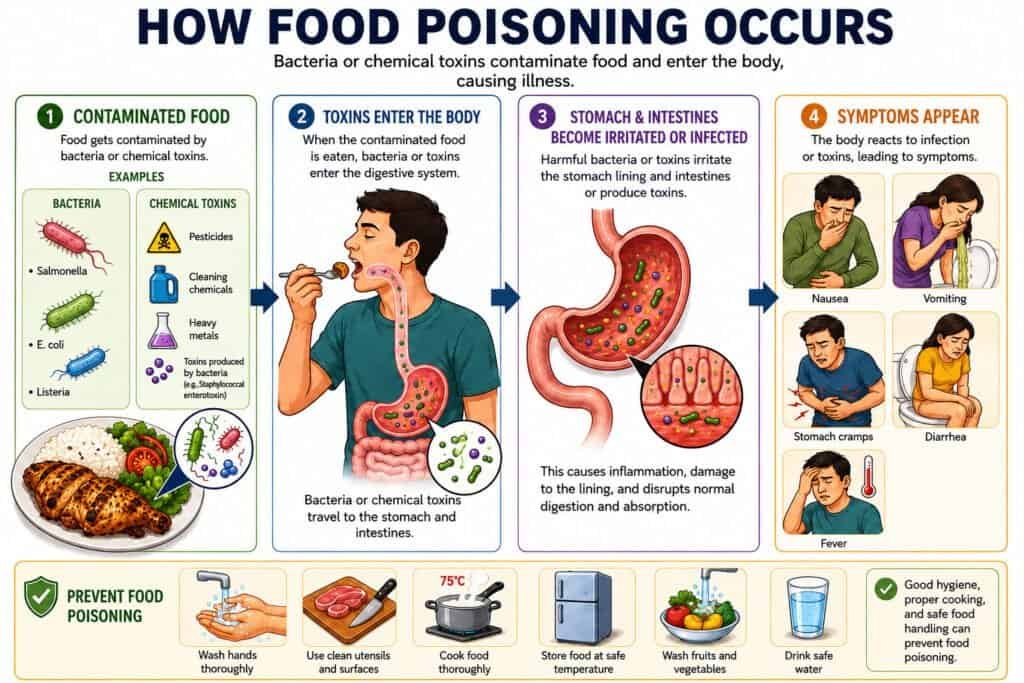
Food Safety in Focus: A Growing Global and Local Concern
Food-borne diseases are responsible for at least 200 different illnesses worldwide, touching not just health
but livelihoods, education, and economies yet the vast majority are preventable. This year’s World Food
Safety Day (June 7, 2026) theme, From Burden to Solutions Safe Food Everywhere, underscores that the
weight of unsafe food falls hardest on children, who suffer the greatest health consequences.
Advisories by Year 2026
Prevention Strategies
The WHO’s Five Keys to Safer Food provide a practical framework applicable at every level of the food chain:
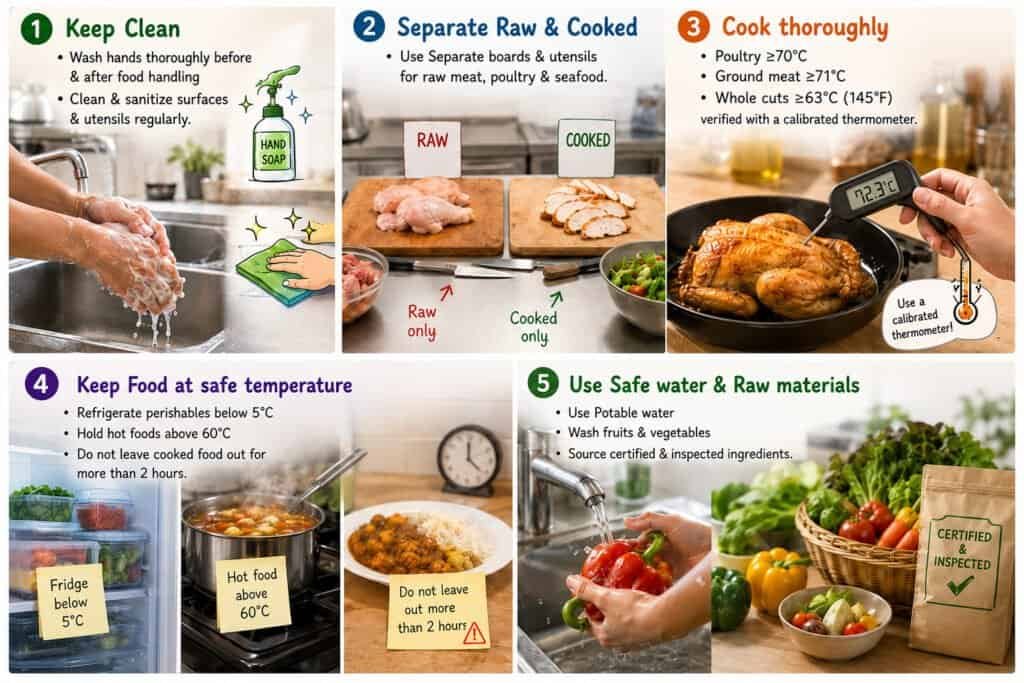
Consumer Risk Reduction
- Maintain refrigerator temperature below 5°C
- Use Separate, colour coded chopping boards for raw meat & ready-to eat foods.
- Use safe utensils to handle food.
- Follow the proper temperature controls for handling food.
- Wash hands with soap & water for at least 20 seconds before & after food preparation.
- Do not wash raw chicken, it spreads campylobacter to surrounding surfaces.
Conclusions
Food poisoning is a preventable public health issue that can be reduced through safe food handling and awareness of food hazards. Protecting vulnerable groups and following measures such as the WHO Five Keys to Safer Food, effective regulations, and good hygiene practices can help ensure safer food and better health for everyone.
Food safety is a shared responsibility. By following safe food practices and effective regulations, we can reduce foodborne illnesses, protect consumer health, and ensure overall well-being. Continuous monitoring and the use of scientific approaches and advanced technologies help identify the root causes of food safety issues, strengthening food security and protecting consumer health. Regardless of the type of food consumed, ensuring food safety remains essential for overall health and well-being.
References
- FoodSafety.gov — U.S. Food Safety Information (HHS) https://share.google/GyPg4VbMMNg0A4goL
- Definition & Facts of Food Poisoning NIDDK https://share.google/15IgVk9V7ibadyfKo
- Food Poisoning Risk Factors https://share.google/SC5c3WcKWqJY1GvdU
- Foodborne Pathogens & Risk Assessment https://share.google/IdajLeXm8tS6wEMDN
- Food Safety Risk Prevention Strategies https://share.google/JrWqrja4RBLDGAYZY
- Epidemiology & Statistics of Food Poisoning Risk https://share.google/4zQHMRxH9nLAVRapw
- Clinical Risk Management in Foodborne Illness https://share.google/fsu8e4RDeWwHYvrp4
- Food Safety Regulatory Frameworks & Risk Governance https://share.google/40xBTrMPA0a0KpXux
- Food Contamination Risk Pathways & Outbreaks https://share.google/k1JCBAwrBKRWEus9a
- Food Handler Risk Behaviours & Training https://share.google/ehsfXzMvguYVcOwGl
- Pathogen-Specific Risk Profiles in Food Safety https://share.google/5vsOqvwnLxZv9ucUt
- Global Burden and Risk of Foodborne Disease (WHO) https://share.google/54w99PPEoKSw02oyH
- WHO Five Keys to Safer Food & Risk Reduction https://share.google/28UEIZQhX8eGcSybW
- Food Poisoning Risk in Saudi Arabia: Potential for Prevention (Local Study) https://www.who.int/news-room/fact-sheets/detail/food-safety
- What happens in my body when I get food poisoning? – BBC Science Focus Magazine
- Public Health Advisories from Investigations of Foodborne Illness Outbreaks | FDA
- wfsd26_communication_toolkit.pdf